
Retention Economics: Why growth is impossible without it
Published January 2026
Published Jan 2026
7 min read
AI Summary
Let’s cut to the chase: If your product is good, your subscription brand won’t fail because you can’t acquire customers, it will fail because you can’t keep them.
Let’s cut to the chase: If your product is good, your subscription brand won’t fail because you can’t acquire customers, it will fail because you can’t keep them.
Since 2020, brands have been growing rapidly in a customer acquisition frenzy: growth teams have been pumping more and more dollars into ads, aiming to increase first-purchase AOV and push harder at the top of the funnel. And so far it’s working, but it won’t forever. Because even the fastest-growing brands have started hitting the same wall: ever-rising CAC, shrinking margins, and flat LTV.
And the main reason behind this? Broken retention economics.
I know this because I’ve worked with 15 category-defining, fast-growing 8 and 9-figure CPG brands, and I’ve seen things from within.
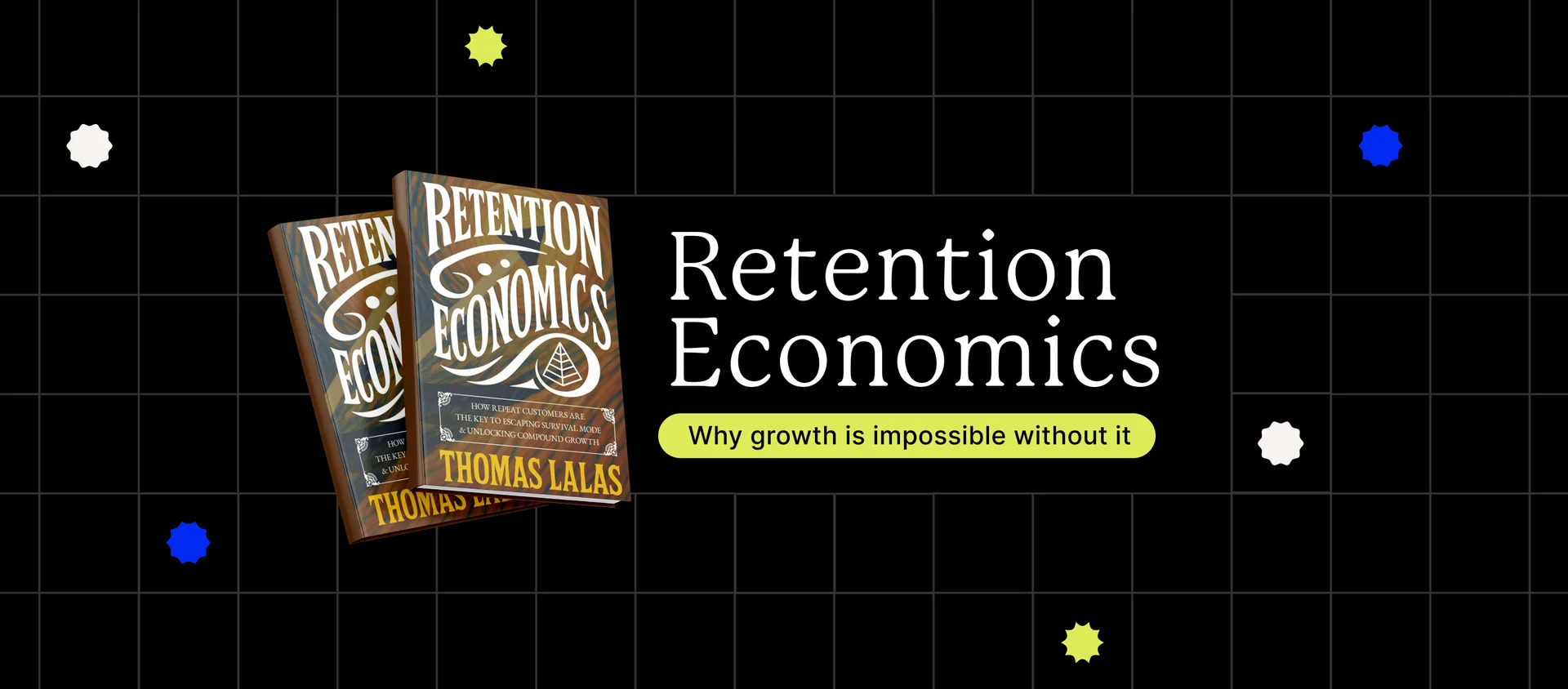
In today’s guide, we’ll explore three concepts from the book Retention Economics that reframe how brands grow fast and what this shift means inside Recharge.
1. Compounding Growth vs. Leaky Growth
While reading the following, try to spot where your brand sits:
Leaky Growth
Leaky growth is deceptively profitable on paper. CAC looks acceptable. Contribution margin appears healthy. Your P&L might even show month-over-month revenue growth.
But underneath the surface, your business foundation is cracking.
If you look hard, inside a leaky P&L you can spot:
- A declining percentage of returning customers
- Each new month requiring more spend to replace churn
- A long payback period, turning each new buyer into a liability
But most importantly cash flow tightens—slowly then suddenly (especially after a big promo, like BFCM).
Brands operating with a leaky bucket often believe the problem is “CAC is getting too high,” which is true, but it’s not the main issue.
In reality, the problem is that retention is too low and LTV doesn’t grow to support the ever-increasing CAC. As Retention Economics explains: most 8 and 9-figure brands lose 80-90% of their customers within 12 months, regardless of how strong the top of the funnel looks.
When 90% of your customers disappear within a year, long-term growth becomes mathematically impossible.
Go check your analytics. What’s your 12-month retention rate? I guess not any close to 20%.
Compounding Growth
When retention is healthy and 12-month LTV is optimized, every new buyer becomes an appreciating asset.
The same $1 spent on acquisition produces disproportionately more revenue because:
- More buyers become a 2nd, 3rd, or 4th+ time customers
- Upsells, cross-sells, and replenishment compound your LTV
- You can afford a higher CAC because your LTV can support it
But more interestingly, you can grow through your own reinvested profits, without external cash injections. This means your growth is not a bubble anymore.
Conclusion? You don’t need 2× more customers. You need the same customers to buy a 2nd time or more.
By fixing your broken retention economics, the same $1 spent on acquisition can be worth 2-5x more in LTV.
2. The Retention Contribution Margin (RCM)
Most ecomm metrics were designed for a different era, one where acquisition was cheap, competition was light, and “break-even on first order” was sufficient for fast growth.
But the playbook has changed.
Modern brands compete in tighter markets, higher CAC environments, and subscription-heavy models. Paper profitability—ROAS, MER, blended CAC—no longer tells the complete story.
Retention Economics introduces a metric built specifically for this new environment: Retention Contribution Margin (RCM).
RCM answers a single question:
“After fulfilling orders, covering COGS, and paying for CAC, is my brand actually cash-positive or am I borrowing from my future profits, like a ticking bomb?”
Unlike most one-dimensional metrics, RCM is directly influenced by your:
- Retention Rate
- Contribution Margin
- Blended CAC
- COGS
- Payback Period
- 12-Month LTV
Meaning an economically well-structured brand will have a high RCM, while a struggling brand will have an ever-decreasing negative RCM.
Most importantly, RCM exposes the gap between brands that look profitable and brands that are profitable.
This is why the book emphasizes the elegant but unforgiving equation:
If RCM ≥ OCAS, then compounding, self-funded, market-share-stealing growth is inevitable.
(OCAS = Operational Expenses + Next Month’s Customer Acquisition Cost + 3 Months of Stock)
Strong retention isn’t a “nice to have” anymore. It’s the clear path towards profitability and compound growth.
3. From “Profitable On Paper” to “Cash Flow Rich”
Acquisition delivers customers. Retention creates cash flow. And cash flow, not revenue, is what funds growth.
But there’s an issue that even established 8 and 9-figure brands face:
They unintentionally design their business around one-off transactions. They optimize their homepage, PDP, ads, and offer strategy for the first order, and then they completely ghost the buyer! Too late – now your brand is dead.
So let’s talk about how to build for repeat buyers from day one using Recharge.
Retention Economics offers a crucial insight:
The first 14 days after purchase determine the LTV of a customer.
This is where most brands unknowingly lose their profitability.
Instead, structure your entire customer experience around repeat behavior, not as an afterthought, but as an operating model.
Here’s what that looks like in practice:
1. Build a subscription-first offer, don’t just slap a “Subscribe & Save” button
A lazy “subscribe & save” option is not a subscription strategy.
- Make subscription the default.
- Incentivize subscriptions with a better deal than one-time purchases.
- Craft offer trifectas: a 1-pack, 2-pack, and 3-pack with tiered pricing and perks (e.g. free shipping at 2-pack or above, extra freebie at 3-pack).
- Boost day-zero AOV with post-purchase and checkout cross-sell.
Then follow up with personalized, value-rich onboarding automations, supported by clear product benefit timelines, founder-led messaging, and habit-building routines.
2. Design the first 14 days as an extension of the product
The entire battle for retention is won or lost in the first 30 days – especially the first 14.
That’s why I created The Vitruvian: the retention system developed to engineer early wins, reduce uncertainty, and form daily rituals increasing retention and LTV as a result.
Your 14-day goals are to:
- Collect zero-party data via a founder-first survey to personalize their journey,
- Combat pre-delivery skepticism by providing a lot of upfront value and care before they even receive their order, and
- Overcome the post-delivery adoption gap by onboarding the buyer, engineering & celebrating quick wins.
When this window is engineered properly, retention compounds drastically.
3. Push subscribers beyond the Churn Point (Month 4)
Every brand has a Month 4 “churn wall.” Buyers who cross it churn much, much slower afterward.
Recharge gives brands the levers to do this effectively:
- 3-month supply offers to early loyalists
- Early renewal reminders tied to running-low logic
- Value-driven billing reminders that highlight upcoming freebies and program perks
But my favorite hack?
Add a highly desirable gift in Month 4, and promote the upcoming rewards during the first 30 days of their subscription.
Make them feel a strong desire to stay at least till Month 4, so they can experience the product’s benefits and collect all of their cool freebies simultaneously!
The result?
With higher Month 1 retention, stronger AOV (via upsells/cross-sells), and lower churn, LTV climbs. And this will transform your brand from “profitable on paper” to “cash-flow rich.”
Conclusion? Growth without retention is a bubble. You’re borrowing from future profits.
Retention Economics makes it clear: the brands that win in 2026 and beyond won’t be those with the best ads.
They’ll have the healthiest RCM, the strongest first-14-day experience, and the most robust subscription-first model powering repeat behavior at scale.
Recharge has created the infrastructure to make it all scalable.
You can read Retention Economics in full here: artecomm.co/retention-economics
Categories


Related articles
Explore additional content that complements what you’ve just read.

Choosing the right payment processor for your DTC subscription program

Recharge welcomes two new elite agency partners
The 6 Levers for Retention-Backed Growth In 2026

The First 30 Days: Where Your Retention Is Won or Lost

Why your ecommerce tech stack is critical for subscription growth and lower TCO