
Subscription churn is front-loaded: the first reorder matters more than acquisition
Published July 2026
Published Jul 2026
Updated August 2026
Updated Aug 2026
7 min read
AI Summary
About 61% of subscription cancellations hit the first two renewals. The first reorder is the retention cliff. Based on data from 20,000+ subscription brands.
Stitch Fix just launched Vision, a feature that uses AI to show subscribers what a recommended outfit looks like on them before the box ever ships. The company built it to fight the single biggest reason styling subscriptions lose customers: the gap between what a shopper pictured at signup and what actually showed up at the door.
It is a bet on one moment. Get the first delivery right, and the customer stays.
Stitch Fix is an apparel company, and it does not run on Recharge, so it is not in the data below. What carries over is the mechanic. The first delivery is where a subscriber decides whether the reality matched the pitch, and that decision plays out the same way whether the box holds a sweater, a bag of coffee, or dog food.
So if the first delivery is where a subscription is won or lost, is that where subscribers actually quit?
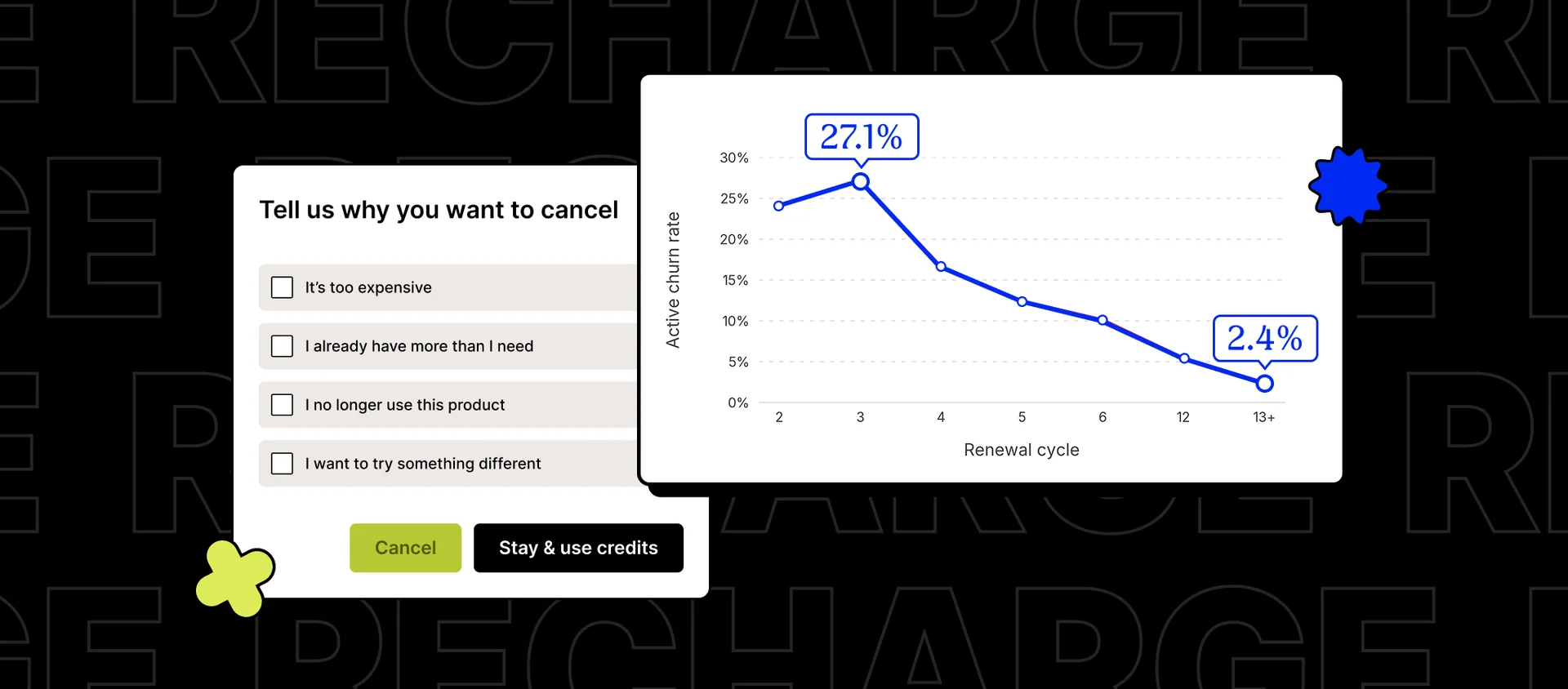
While we can’t see confidence signals like previews or predicted fit in our data, we can see exactly when subscribers cancel, and the timing is blunt. Subscription churn is front-loaded. About 61% of all voluntary cancellations happen at the first two renewals, and roughly 72% land within the first four. Voluntary churn means a subscriber actively chose to cancel, and it peaks at the third renewal cycle near 27% before falling to about 5% by the twelfth.
The first reorder, not the first sale, is where the program is won or lost.
Our take: this is a map of where to spend retention effort, not proof that any one tool fixes it.
When does subscription churn actually happen?
About 61% of voluntary cancellations happen at the first two renewals, and roughly 72% within the first four.
Most churn benchmarks get quoted as a single monthly rate, which tells you how much you’re losing but not when. The renewal-cycle view tells you when, and it is lopsided. Here is voluntary churn by renewal cycle across the platform.
| Renewal cycle | Active churn rate |
|---|---|
| 2 (first renewal) | 24.1% |
| 3 | 27.1% |
| 4 | 16.6% |
| 5 | 12.4% |
| 6 | 10.1% |
| 12 | 5.4% |
| 13+ | 2.4% |
Read down the column and the shape is a cliff, not a slope.
The first renewal (cycle 2) already sheds 24.1% of the subscribers who reach it. Cycle 3 is the peak at 27.1%. Then it drops fast: 16.6% at cycle 4, about 10% by cycle 6, and roughly 5% by cycle 12. One quick definition, because it matters here. Cycle 1 is the initial checkout order, so the first real renewal decision is cycle 2. And active churn is a subscriber choosing to cancel, which is separate from a failed payment.
That puts your highest-leverage retention work at the first reorder, not at the first sale.
The counterintuitive part: consumables churn earlier than apparel
Food, pet, and health brands lose more subscribers at the first renewal than fashion and apparel brands do.
The Stitch Fix story frames expectation mismatch as a fit-and-styling problem, the kind you would expect to bite hardest in apparel. Recharge’s data inverts that.
Split first-renewal churn by category and the consumables sit at the top.
| Vertical | First-renewal (cycles 2-3) churn | Mature (cycle 6+) churn |
|---|---|---|
| Food & Beverages | 28.2% | 6.4% |
| Pets | 27.8% | 6.5% |
| Health & Wellness | 26.5% | 7.5% |
| Beauty & Personal | 26.3% | 8.5% |
| Home Goods | 23.4% | 12.3% |
| Fashion & Apparel (thin base) | 16.1% | 5.6% |
Food and beverage leads at 28.2%, with pets (27.8%), health and wellness (26.5%), and beauty (26.3%) close behind.
Fashion and apparel sits at the bottom at 16.1%.
That apparel figure rests on a comparatively thin base on Recharge, so read it as directional. But the ranking is clear, and across every vertical the first-renewal churn runs three to five times the same category’s mature-cycle rate.
It makes sense when you think about what a first reorder is. For a consumable, the second box is the moment a shopper decides whether they wanted this thing again, on a schedule, at this price. That verdict arrives fast, and it arrives for coffee and supplements just as surely as it does for a sweater. If you sell a consumable, your expectation-mismatch problem is probably bigger than the apparel-framed version of this story implies.
Is the pattern real, or just churn-prone new stores?
A same-store group of established brands shows the same cliff, so the front-loading is real behavior, not a mix effect.
There is an obvious objection. Maybe the curve is an artifact: a wave of new brands with rough first cohorts dragging the whole platform down, while established brands look nothing like it.
So we checked.
Restrict the data to a same-store cohort, brands that were already live before the window and stayed active through it, and the curve barely moves. The third-cycle peak still sits near 27% and still decays toward the low single digits by cycle 12 and beyond.
That is the tell that this is structural. Front-loaded churn is a property of how subscriptions behave, not a quirk of who joined the platform recently.
Why the first reorder is the highest-leverage moment (and what this data can’t say)
A point of churn saved at the first reorder is worth far more than the same point saved later, because that is where the volume is.
The gap between cycle 3 (27.1%) and cycle 12 (about 5%) is the whole argument for where retention effort belongs. Move retention up a point at the first reorder and you touch far more subscribers than the same gain deep in the lifecycle, because that is where the cancellations pile up. This is the moment Stitch Fix’s try-on is built to protect, generalized from styling to all of subscription commerce.
A caveat: Recharge does not observe previews, predicted fit, or quiz completion. So this data shows where the highest-leverage churn moment is. It does not show that any confidence tool reduces churn. It measures the battleground, not the weapon. Anyone who tells you a preview feature cut churn owes you the before-and-after. What the data can tell you is where to point the effort.
What should subscription operators do about it?
The first-reorder cliff points to three moves, and none of them is buy more first orders.
- Read churn by renewal cycle, not a blended monthly rate. A single monthly number averages the cliff away. Break it out by cycle in your subscription analytics and find where your own curve peaks, because it is probably earlier than you think.
- Match the save to the cancel reason. A flat, one-size offer wastes the moment, so tailor cancellation prevention to why someone is actually leaving. Open Farm cut churn nearly 29% and Wildgrain saved 22% of cancellations doing exactly this, and both sell consumables.
- Get ahead of the cancel. The best save is the one you never have to trigger, so use the first few deliveries to set expectations and build the habit. That early lifecycle work is the proactive half of churn prevention.
And if you sell a consumable, treat the first reorder as your make-or-break moment. The data says that is where your category leaks first, so that is where the attention belongs.
There is a platform subtext here for anyone weighing a move. You can only run this play if your system shows you churn by cycle and lets you tailor the save to the reason. If your current setup can only show you a blended monthly rate, you are flying blind at the exact moment that decides the customer. It is the kind of cross-brand read behind our Subscription Trend Report.
About this report
These figures come from renewal-cycle data across subscription brands on Recharge, spanning food and beverage, pets, health and wellness, beauty, home goods, and fashion and apparel.
The window covers renewal cycles dated July 2025 through March 2026, with the end held back far enough that cycles had at least three months to resolve. We measured active churn, meaning a subscriber-initiated cancellation, on resolved cycles only, and grouped brands by vertical. Every figure is aggregated across brands, and no single merchant’s numbers appear.
Two caveats worth stating plainly. This is a proxy: it shows where cancellations concentrate, which is a signal of expectation-mismatch risk, not a measurement of any confidence tool or its effect. And the fashion and apparel figures sit on a thinner base than the consumable categories, so treat them as directional.
Frequently asked questions
Cancellations cluster at the first two renewals. On Recharge, about 61% of voluntary churn lands at cycles 2 and 3, and the rate falls steadily as subscribers mature.
Yes. In Recharge’s data, consumables like food and beverage (28.2%), pets (27.8%), and health and wellness (26.5%) show higher first-renewal churn than fashion and apparel (16.1%).
Benchmarks vary by category and are usually quoted monthly, but the more useful question is where your churn concentrates. If most of it sits at the first reorder, that is where the fix lives.
Categories


Related articles
Explore additional content that complements what you’ve just read.

Inside ChargeX East: How the best brands are driving retention in the agentic era

2026 Black Friday marketing strategy for subscription brands

The quarterly upgrade: subscription retention’s most underused lever

CPG product sampling: why a $0.99 intro offer retains subscribers nearly 4× better than a free one
The first-order discount sweet spot for CPG subscription brands is deeper than you think