

How does supplement subscriber retention compare with other verticals?
Published July 2026
Published Jul 2026
Updated October 2026
Updated Oct 2026
8 min read
AI Summary
Supplement subscriptions have the leakiest first reorder of any consumable category, with only 86.6% of first-time buyers placing a second order. Subscribers who clear that hurdle retain about as well as other verticals, helped by the highest skip rate (6.9%) and low active churn (17.3%). The fix is focusing on first-reorder onboarding, turning cancels into skips, and timing reminders to run-out.
Supplements retain subscribers better than most other verticals. You don’t have to read the rest!
In August, Procter & Gamble agreed to buy the clinical-supplement brand Thorne from L Catterton for $3.8 billion in cash, with the deal expected to close in the fourth quarter. A price like that made me ask how long supplement subscribers stay, so I looked at roughly 1,750 supplement brands on Recharge to see how they compare with other verticals.
Of the people who place a first order on a supplement subscription, 75.2% place a second one, the highest rate of the six verticals analyzed.
Let’s dig in.
What does the supplement retention curve look like?
A supplement subscriber is likeliest to leave right after the second order.
The figures below measure order-sequence retention, meaning Recharge followed first-time subscribers who completed an initial order and tracked the share who went on to complete each subsequent order.
Definition time (because this has tripped me up in the past): the first reorder is a subscriber’s second order (duh), so the twelfth reorder is their thirteenth. Supplement subscribers reorder roughly every 30 days, so the twelfth reorder lands about a year after the first order, a little later when subscribers skip.
| Reorder | First-order subscribers counted | Completed it | Share |
|---|---|---|---|
| 1st | 6,588,970 | 4,957,896 | 75.2% |
| 2nd | 6,578,895 | 3,229,591 | 49.1% |
| 3rd | 6,568,557 | 2,259,947 | 34.4% |
| 6th | 4,843,348 | 750,292 | 15.5% |
| 9th | 2,942,336 | 261,673 | 8.9% |
| 12th | 1,394,817 | 79,553 | 5.7% |
The group shrinks at the later reorders because each one counts only cohorts old enough to have reached it.
Read as a share of the original group, the loss is front-loaded. Of every 100 subscribers who place a first order, about 75 place a second, 49 place a third, 16 place a seventh and 6 place a thirteenth. The first reorder loses a quarter of the group and the second loses another 26 points. More than half of the subscribers who are gone by the twelfth reorder were already gone by their third order.
75% of first-order subscribers place a second order, but only about 65% of second-order subscribers place a third, the worst step on the curve. The next step improves to 70%, and from the seventh reorder on roughly four in five of the subscribers still ordering place the next one.
That steady one-in-five loss per order is why the tail looks flat. The drops shrink from 26 points at the second reorder to one to three points per reorder in the tail because fewer subscribers are left to lose, while the share lost at each order stays about the same. The step into the third order loses more subscribers than any other step, which makes it the step where a retention fix has the most subscribers to save.
The 5.7% at the twelfth reorder is 79,553 of the 1.39 million first-order subscribers in cohorts old enough to have reached it, still ordering a full year after their first order. Every vertical measured at that point lands in single digits.
How supplements compare with other verticals
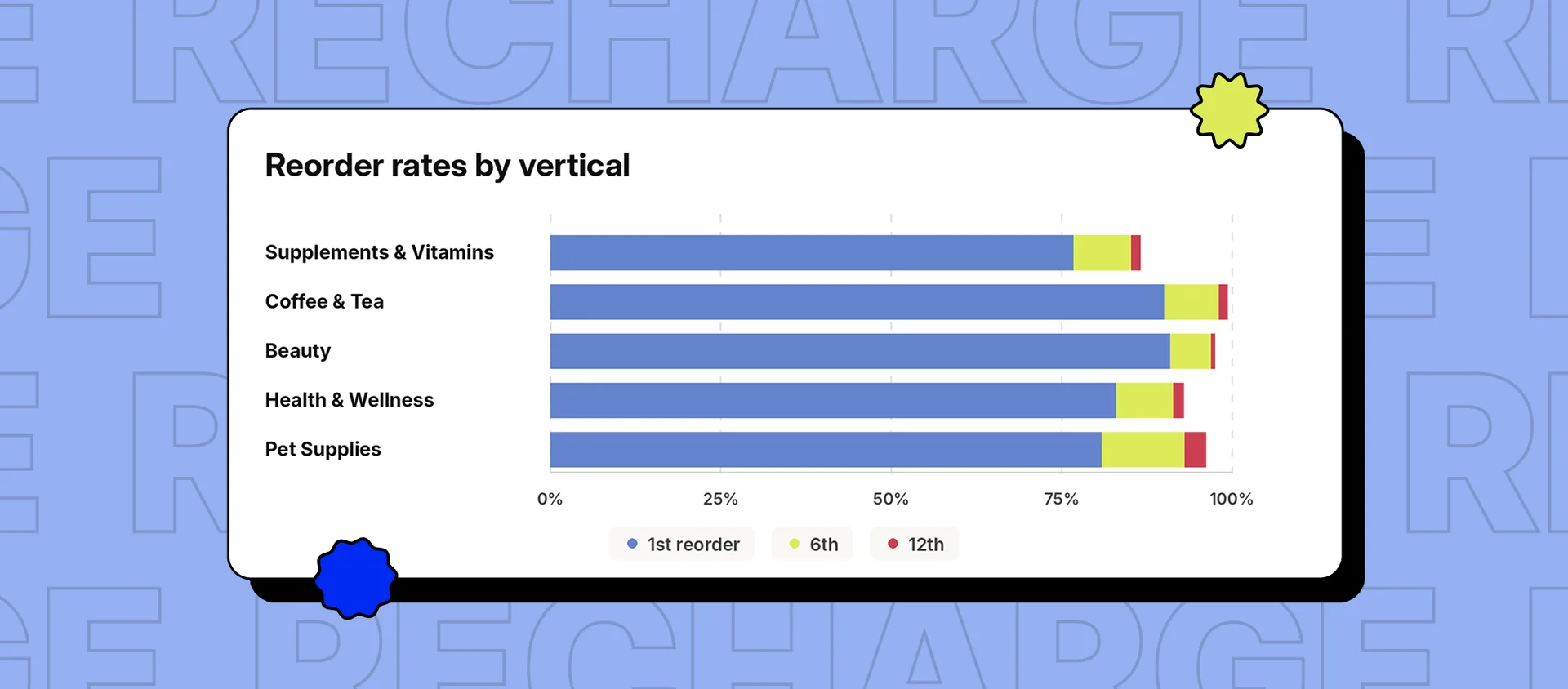
| Vertical | 1st reorder (second order) | 3rd | 6th | 12th | Subscribers counted at 12th |
|---|---|---|---|---|---|
| Supplements & Vitamins | 75.2% | 34.4% | 15.5% | 5.7% | 1,394,817 |
| Coffee & Tea | 73.3% | 26.8% | 12.2% | 5.0% | 1,010,613 |
| Pet Supplies | 71.7% | 26.8% | 18.8% | 8.3% | 423,251 |
| Health & Wellness | 69.4% | 30.0% | 14.0% | 5.6% | 838,461 |
| Food | 63.1% | 30.0% | 17.1% | 7.9% | 391,398 |
| Beauty* | 71.0% | n/a | n/a | n/a | n/a |
*Beauty subscribers reorder about every 60 days, against about 30 for the other five verticals, so most cohorts in this data haven’t had time to reach beauty’s later reorders. The figures that exist there would only reflect its fastest subscribers, so they’re left out.
Supplements lead at the first reorder, tie pet for the lead at the third, and land in the middle of the pack at the sixth and twelfth, behind pet and food.
The lead fades along the way. Supplements start about six points ahead of health and wellness at the first reorder and finish level with it at the twelfth, and their 12-point lead over food at the first reorder becomes a 2-point deficit.
The gaps between verticals also widen at each reorder shown. Among the five verticals with figures at every reorder, the best is about 1.2 times the weakest at the first reorder and about 1.7 times at the twelfth, so small differences in how many subscribers each vertical loses per order compound.
A brand should benchmark against its own vertical’s row, since a 70% first-reorder rate sits below the supplement average and above the food average.
What the renewal data adds
Renewal-cycle data shows what subscribers do at each scheduled order. Process rate is the share of scheduled orders that were charged, skip rate is the share skipped, and active churn is the share that ended with the subscriber canceling. Everything else is involuntary churn, other lost orders and orders still queued or in recovery, so each row adds up to 100%.
| Vertical | Process rate | Skip rate | Active-churn rate | Everything else |
|---|---|---|---|---|
| Food | 68.8% | 6.3% | 13.3% | 11.6% |
| Pet Supplies | 76.9% | 2.2% | 15.6% | 5.3% |
| Supplements & Vitamins | 72.3% | 5.8% | 17.8% | 4.1% |
| Health & Wellness | 70.7% | 4.8% | 18.7% | 5.8% |
| Coffee & Tea | 72.1% | 3.3% | 21.1% | 3.5% |
| Beauty | 69.1% | 3.9% | 21.2% | 5.8% |
Food’s everything-else figure is the largest because 8.9% of its cycles ended in a loss that wasn’t a cancel, a skip or involuntary churn, against 2.2% or less for the other verticals. Leaving out the stores where those losses cluster pushes Food’s churn and skip rates up and leaves supplements’ rank where it is.
Supplements’ active churn of 17.8% is third lowest of the six, behind food and pet, which fits where they land in the tail of the retention curve.
Supplements skip more than any vertical except food, and a skip is a warning sign. Of the supplement skips between July 2025 and March 2026, 59% were followed by another order, against 78% after a normally processed order. A high skip rate points to subscribers at higher risk of leaving.
The typical store looks like the aggregate, so the vertical average describes the typical supplement brand. Among supplement stores that were already active before July 2025 and still are, 72.5% of cycles processed, 6.0% were skipped and 18.0% ended in active churn. The median of the 1,174 supplement stores with at least 500 renewal cycles sits at 17.0% active churn, close to the aggregate. Subscribers handle all of this in the customer portal, where they can skip, swap, pause or cancel.
Where supplement brands can move the curve
The step into the third order loses more subscribers than any other, so that’s where a supplement or health-and-wellness brand should start. Before that order, explain dosing, what results to expect and by when, and why finishing each supply matters.
A skip still holds up far better than a cancel, since subscribers who canceled at the cancel screen placed another order under 2% of the time. Cancellation Prevention puts an offer in front of a subscriber at that screen, and supplement subscribers who accepted one between July 2025 and March 2026 placed another order 44% of the time after a skip, 49% after a discount, 53% after a delay and 66% after a swap. Those figures describe the subscribers who accepted each offer, so they don’t show which offer works best, only that every one of them keeps a real share of the people who were about to leave.
With a roughly 30-day cadence, a reminder just before the supply runs out gives a subscriber a moment to adjust the date or confirm the order before they think about canceling.
More cross-vertical patterns are in the Subscription Trend Report.
About this report
These figures come from Recharge platform data covering roughly 1,750 supplement brands.
The retention curves follow acquisition cohorts from July 2025 to June 2026 and report, among subscribers who completed a first order, the share who completed each later order. Each reorder counts only cohorts old enough to have reached it at a monthly cadence, so the 6th reorder reflects cohorts through March 2026 and the 12th reflects cohorts through September 2025. Because each reorder counts a different set of cohorts, the tables are for comparing verticals at the same reorder, so don’t read them as one cohort’s path. The step-to-step figures in the curve section (about 65% after the second order, about 70% after the third, roughly four in five from the seventh reorder on) work differently. Each one compares a reorder with the one before it, using only cohorts old enough to have reached both, so they can’t be rebuilt by dividing one table row by another. Subscribers on slower cadences, or who skip, may not have reached a given reorder yet, so the later figures likely understate the true tail.
Store cohorts in which fewer than half of the subscribers had a first order on Recharge were excluded, because that pattern points to a merchant importing an existing subscriber base instead of acquiring new ones. For supplements this removed 59 store cohorts covering roughly one million imported subscribers.
Cadence is the median gap between a subscription’s processed orders: 30 days for supplements and about 60 for beauty. The renewal rates cover cycles from July 2025 to June 2026. The figures on what follows a skip or a processed order use a 10% sample of subscriptions, covering orders and skips from July 2025 through March 2026, followed through September 2026. The cancel-screen figures cover every supplement cancellation flow from July 2025 through March 2026 in which the subscriber accepted an offer, followed through September 2026.
Six verticals are compared: supplements, coffee and tea, beauty, health and wellness, pet supplies and food. Every figure is aggregate at the vertical, cohort or merchant-distribution level, and no single brand or store is identified. “Supplements & Vitamins” is the store’s own category classification, so it covers supplement brands in general and says nothing specific about Thorne’s subscribers.
Frequently asked questions
On Recharge, 75.2% of supplement subscribers who place a first order go on to place a second, about half reach a third order, and 5.7% are still ordering twelve reorders deep.
Supplements retain better than coffee and tea at every point on the curve. Against beauty, only the first reorder is a fair comparison, and supplements lead there, 75.2% to 71.0%, because beauty subscribers reorder about every 60 days and the data can’t yet reach its later reorders. Pet and food both retain better than supplements in the tail.
The largest single drop comes at the second reorder, when the group falls from 75.2% to 49.1%. Of the subscribers who place a second order, only about 65% place a third, the worst odds at any step on the curve.
Categories


Related articles
Explore additional content that complements what you’ve just read.

Inside ChargeX London: Retention in the age of AI, from the brands leading in EMEA

Inside ChargeX East: How the best brands are driving retention in the agentic era

2026 Black Friday marketing strategy for subscription brands

The quarterly upgrade: subscription retention’s most underused lever

CPG product sampling: why a $0.99 intro offer retains subscribers nearly 4× better than a free one