
2026 Black Friday marketing strategy for subscription brands
Published September 2026
Published Sep 2026
27 min read
AI Summary
Black Friday subscribers can be among a subscription brand's best customers — if the offer is built correctly. The key is using BFCM to sell quarterly and annual plans rather than discounting monthly prices. Annual subscribers retain nearly 6x better at month 13, and deeper discounts don't improve outcomes.
Most subscription operators carry a quiet suspicion about the Black Friday subscriber.
They signed up because it was cheap.
They’ll churn the moment they pay full price.
Buying them is just renting revenue for a quarter.
Good news: the data says otherwise.
Black Friday subscribers can be some of the best customers a subscription brand (that s word’s doing a lot of heavy lifting!) acquires all year, if the offer’s built correctly. The brands that get it wrong waste precious margin shaving down their monthly price. The brands that get it right push holiday shoppers towards quarterly and annual plans.
tl;dr
- Use BFCM to sell quarterly and annual plans rather than chiselling down your monthly price.
- Black Friday is the one week of the year when shoppers actually reach for a longer commitment: annual plans make up 7.2% of Black Friday subscription signups against 3.1% in January, and nearly a third of Black Friday subscribers pick something longer than monthly.
- Those longer plans are the ones that last. 59% of annual Black Friday subscribers are still active at month 13, just past the renewal decision, against 9.4% of monthly subscribers.
- Discounting does cost you, but it’s worth it. A subscriber who buys an annual plan at half off still retains almost three times better than a monthly subscriber who paid full price.
- Run it for the five days, not for the month. There’s no demand ramp before Thanksgiving, and the annual plan is the one thing that only really sells inside the window.
I looked at a lot of subscription data to uncover these kernels and more. Enjoy.
Where subscriptions sit going into BFCM 2026
From January 1st to September 10th (when I pulled this data), here’s is the state of subs compared to the same period last year, broken out by vertical:
| Vertical | New subs YTD | Net first order AOV | % of first orders discounted | Avg first order discount (of those discounted) |
|---|---|---|---|---|
| Health and Wellness | 11.7M to 14.2M (+21%) | $51.34 to $50.83 | 47.3% to 47.0% | 31.0% to 31.2% |
| Food and Beverage | 10.0M to 11.2M (+12%) | $45.53 to $49.73 | 56.0% to 59.9% | 20.8% to 31.8% |
| Home | 5.35M to 5.34M (flat) | $37.30 to $40.27 | 46.8% to 56.9% | 34.1% to 28.4% |
| Beauty and Personal Care | 11.0M to 9.0M (-19%) | $30.24 to $36.85 | 37.7% to 38.4% | 31.7% to 35.0% |
| Pet | 2.81M to 2.29M (-18%) | $43.41 to $46.49 | 48.3% to 37.7% | 30.5% to 27.2% |
Going into this November, brands are charging more and discounting deeper. Net first order is up in four of the five biggest categories we track; first order discount is drifting up in three of them. Volume has split hard, with two categories up double digits and two down close to 20%.
The volume numbers have an obvious qualification. They count every brand in each category on Recharge, so a category can shrink because shoppers bought less or because a brand contracted, closed up shop, or switched to another platform (like Skio). Per-subscriber averages are less exposed than totals, but they’re not immune either: if the brands that no longer included in the data skewed towards affordability vs. premium , the remaining averages drift up on their own (which is part of why net first order is rising almost everywhere).
Health and Wellness is the growth engine, with order volume YTD up 21% and pricing / promotion both sitting still. This shouldn’t be a shocker if you’ve seen the news. Creatine and greens and novel form factors are everywhere.
Food and Beverage saw the steepest contraction. Average first-order discount has gone from 20.8% to 31.8% among the orders that carried one, and more brands are discounting than last year.
Home is flat on volume and has traded depth for breadth. First order discount was more prevalent than last year, while the average discount is six points shallower. That is the more defensible version of that trade, and nothing in Home’s numbers signals trouble going in.
Beauty and Personal Care is squeezed from both directions: volume down 19%, net first order up 22%, discounts deepening. Here’s hoping for a big holiday season!
Pet is… kind of killing it? The share of first orders carrying a discount has dropped from 48.3% to 37.7% and the average depth came down with it, while Pet holds the best retention in the data. Whether one explains the other is a fair question, but the two facts sit together.
How much does Black Friday actually matter for a subscription brand?
If you sell stuff made for one-time purchase (shackets, couches, espress machines), BFCM is your Super Bowl. Shopify reported $14.6 billion in merchant sales across the 2025 Black Friday weekend, up 27% vs 2024 performance; for a lot of single-purchase retailers that four-day stretch is the difference between a good year and liquidation.
A non-sub brand has to re-win every customer, so a concentrated demand spike based around gifting and discounts makes sense. Subscription doesn’t work like that.
A subscription brand’s revenue comes mostly from people who already bought, which makes any single week a smaller slice of the whole by definition.
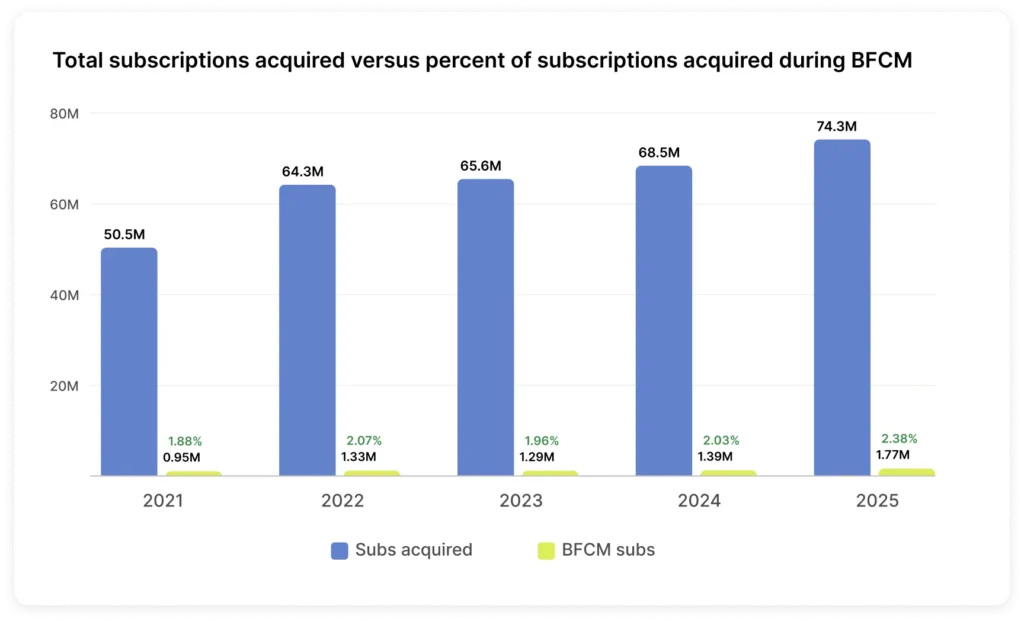
Here’s the last five years of BFCM across Recharge:
| Year | Subscriptions acquired | BFCM subscriptions | BFCM share of the year |
|---|---|---|---|
| 2021 | 50,454,835 | 948,821 | 1.88% |
| 2022 | 64,307,357 | 1,331,008 | 2.07% |
| 2023 | 65,569,860 | 1,285,361 | 1.96% |
| 2024 | 68,503,014 | 1,388,618 | 2.03% |
| 2025 | 74,269,629 | 1,767,388 | 2.38% |
Yes, BFCM is big and important and worth planning for. But it only represents about 2.4% of the new subscribers you’ll acquire all year. So relax, have some shoefly pie (and let your friends who sell frying pans and Henleys sweat instead).
It matters, but it won’t make or break your year
Those five days are 1.4% of the calendar, which makes the week nearly 2X as valuable as any other random week.
That’s not nothing! But you’re not betting the quarter on five days. You’re running a week that reliably delivers a dense cluster of new subscribers. The real question is what to sell them.
BFCM tip: budget the week as a good week, not as your entire Q4. Plan it against a couple of percent of annual acquisition. Brands that treat it as existential end up panic-discounting in the second week of November, and that decision costs them LTV for the next twelve months.
BFCM keeps getting more expensive for subscription brands
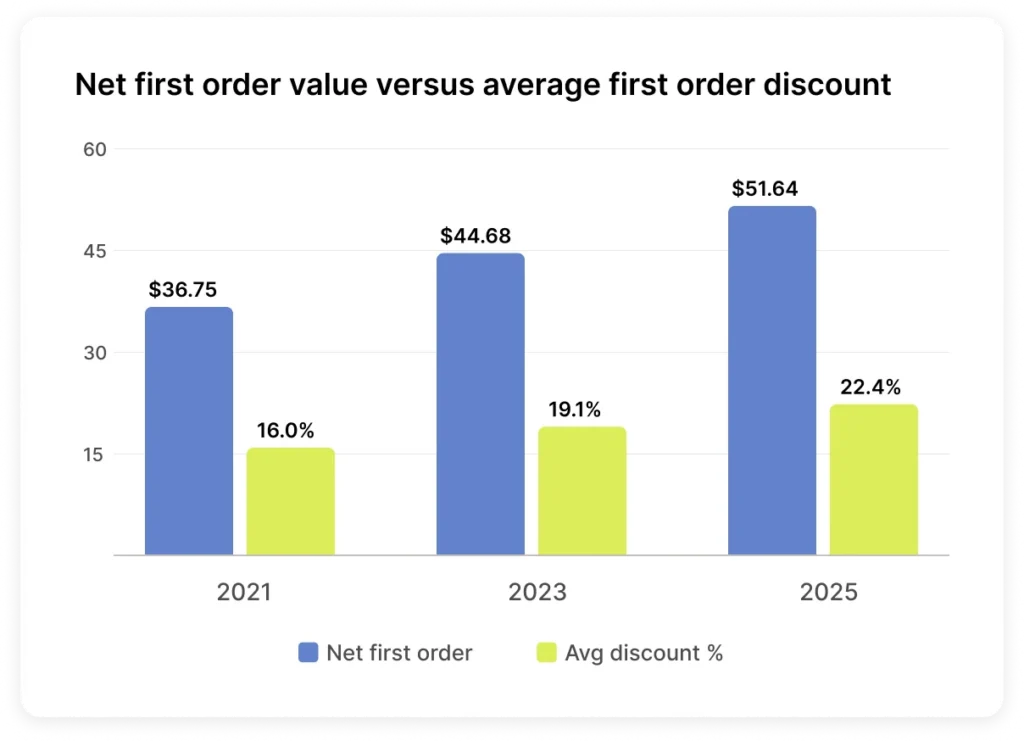
You’re sacrificing more margin to win a BFCM subscriber than you were in 2021, but you’re netting more per order, too.
| Year | Net first order | Avg discount |
|---|---|---|
| 2021 | $36.75 | 16.0% |
| 2023 | $44.68 | 19.1% |
| 2025 | $51.64 | 22.4% |
It’s gotten more expensive and more valuable at the same time.
Two things are happening at once here.
- The average discount has climbed from 16.0% to 22.4%, which means the cost of competing on BFCM has gone up.
- But net first-order value climbed faster, from $36.75 to $51.64, because list prices rose more than the discounts did.
The cost of buying a subscriber has been drifting up everywhere, not only in November. Across Recharge as a whole, just under half of all new subscriptions now arrive with a first-order discount of some kind. Discounting at acquisition has quietly become the default setting for the category rather than a seasonal event, which is exactly why a Black Friday discount number only means anything when you measure it against what that same brand already does the other eleven months of the year.
BFCM tip: margin comes from list price, not from a bigger markdown. Net first-order value climbed from $36.75 to $51.64 across these four years even as discounts deepened, because list prices rose faster than the discounts did. If you need the week to net more this year, the lever that has actually worked is the price you’re discounting from.
New subscribers are more likely to opt for quarterly and annual plans during BFCM
Annual plans are more than twice as common during BFCM as they are in January, and nearly a third of BFCM subscribers opt for something longer than a straight up monthly sub.
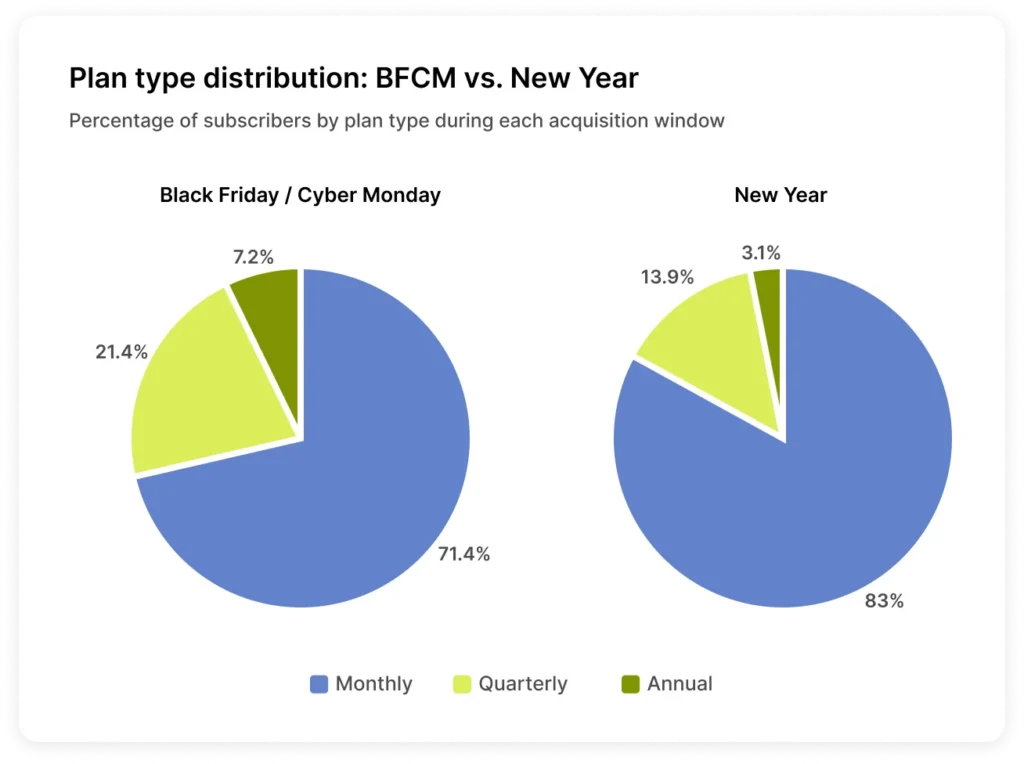
| Acquisition window | Monthly | Quarterly | Annual |
|---|---|---|---|
| Black Friday / Cyber Monday | 71.4% | 21.4% | 7.2% |
| New Year | 83.0% | 13.9% | 3.1% |
New Year, New Me is the logical comparison for BFCM (at least where subscription brands are concerned). It’s a huge focus, particularly for health and wellness, and is seen by many as more important than the holiday season. But it attracts a completely different kind of buyer psychology.
A Black Friday purchase is either for somebody else or a stock-up on something you already know you want, and both of those make a year’s supply an easy yes.
New Year is a resolution. It’s a bet on a version of yourself you haven’t met yet, and people hedge that bet by… not committing! The January cohort isn’t worse because January shoppers are worse. It’s worse because “I think I’ll try creatine when I go to the gym this year” is inherently less valuable than “I already use creatine every day and I want to capitalize on a bulk discount.”
BFCM tip: make quarterly and annual the default on the page, not the upgrade. Most brands still default to a monthly subscription or a one-time purchase and tuck the longer terms underneath. BFCM is the one week where the longer plan is what people came for, so put it first, highlight it, and let monthly be the fallback. It costs nothing and there’s still time to change it before November. If you’re still deciding whether to offer annual at all, we’ve made the case for it separately.
Is Black Friday a gifting moment for subscription brands?
Black Friday looks like a gifting week, it smells like a gifting week, but… it isn’t (at least as far as subscription brands are concerned).
Across a same-store cohort of CPG subscription brands, the share of orders shipped to an address other than the one on the card is 10.19% during the five days, against 9.75% in an ordinary September. December is the month that actually moves.
There’s a version of the Black Friday subscriber most brands don’t build for: the one who isn’t the subscriber at all. Someone buys a three-month coffee plan for their dad, and the person whose card is on file and the person drinking the coffee are two different people. A year of something is a good present. A monthly subscription is a weird one.
We can’t see gifts directly, so we use the closest thing the data has: orders where the billing address and the shipping address don’t match. It’s a rough proxy. Second homes, work addresses, people who just moved and kids at college all land in the same bucket. It’s still worth running, because December proves the proxy picks gifting up when gifting is there.
| Window | Shipped to a different address | Shipped to a different state |
|---|---|---|
| September, an ordinary month | 9.75% | 2.80% |
| November 1 to the day before Thanksgiving | 9.87% | 2.83% |
| Thanksgiving through Cyber Monday | 10.19% | 3.16% |
| December 1 to 24 | 11.61% | 4.04% |
December lifts the gift signal 1.86 points above a normal September. Black Friday week lifts it 0.44. The stricter cross-state version underneath tells the same story. Gifting is real. It just happens in December.
Which changes why Black Friday shoppers reach for the year. A 0.44-point move can’t produce an 11.6-point swing in plan mix. So the reason Black Friday shoppers reach for the year isn’t that they’re buying it for someone else. It’s the other half of that sentence: they’re stocking up on something they already use, and at a discount, a year of it is simply the rational buy. That’s a better fact to plan around than gifting was, because stock-up demand is something you can merchandise to directly.
The gift window opens after your discount window closes.
BFCM is when you sell the long plan to the person who’s going to drink coffee every day.
December’s when you sell it to someone shopping for their dad.
Two different audiences, two different offers.
BFCM tip: build the gift offer for December, not for Black Friday. Don’t spend five days merchandising gifts, because the behavior isn’t there yet. And whenever a gifted term ends, the renewal conversation is with somebody who never chose you, so get the recipient’s own email into the flow early and treat the end of a gifted term as a first-order acquisition moment rather than a renewal.
Quarterly and annual subscribers stick around longer (shocking!)
If you take one thing away from this post, here it is: You should be using BFCM to lock new subscribers into quarterly and annual plans.
Check this retention data out:
| Plan purchased during bFCM | Month 3 | Month 6 | Month 13 | Month 24 |
|---|---|---|---|---|
| Monthly | 26.4% | 16.0% | 9.4% | 5.7% |
| Quarterly | 62.8% | 45.0% | 26.8% | 16.3% |
| Annual | 90.4% | 86.9% | 59.0% | 45.9% |
Among people who subscribe during BFCM, the retention on quarterly and annual plans is genuinely wild.
Quarterly holds 26.8% at month 13, close to three times the monthly rate. And yes, the 3- and 6-month numbers on annual look enormous because those subscribers are locked in, so don’t read much into them.
Why are we looking at month 13 and not month 12? That’s the point where an annual subscriber has actually had to choose again, and 59% of them renew.
Lucky number 13
Everything before month 13 on an annual sub is prepaid and locked in. The renewal is a single conscious choice, roughly a year after somebody bought.
Almost six in ten of them say yes.
Annual Black Friday subscribers sit at 59.0% at month 13, against 9.4% for monthly.
And once they’ve made that call, they stop churning in any meaningful way. The curve is flat afterwards, 53.6% at month 18 and still 45.9% at month 24. A monthly subscriber needs to be won back twelve times a year. An annual subscriber is a golden goose.
BFCM tip: decide now that you’ll judge this cohort at month 13. Write it down before the campaign runs. If you evaluate in March on order counts, you’ll conclude your best subscribers were your worst ones, and you’ll fix the wrong thing.
So longer plans keep subscribers. Which raises the question you probably came here with, because you were going to discount something regardless: if the plan matters that much, where should the discount go?
Put your deepest discount on your longest plan
The discount you choose matters far less than the plan you attach it to.
Here’s a breakdown of the share of BFCM subscribers still subscribed at month 13, based on first-order discount percentage:
| Plan | Full price | 1 to 25% off | 26 to 50% off |
|---|---|---|---|
| Annual | 59.4% | 58.5% | 42.4% |
| Quarterly | 30.7% | 28.0% | 20.7% |
| Monthly | 16.0% | 11.8% | 10.3% |
Compare the worst annual outcome with the best monthly one. An annual subscriber you sold at half off retains at 42.4%. A monthly subscriber who paid you full price retains at 16.0%. You gave away half your first-order revenue and still ended up with a customer worth nearly three times as much.
That’s the trade.
Depth does cost you a few points inside a plan, which lines up with what we found on the first-order discount sweet spot. It’s a dial you can nudge; plan length is a switch you can throw. If you’ve only got the margin to pull one of them this November, go all in on the plan length
BFCM tip: put your deepest discount on your longest plan, and cap it at 50%. Don’t spend your margin taking monthly from 20% off to 40% off. Spend it making the annual plan the obvious buy, and pair it with something that isn’t price, like a free gift or a bonus shipment, so the offer still lands as an offer. The quarterly upgrade is the most underused version of this move, and BFCM is the week it’s easiest to pull. Above 50% off the data gets thin and starts mixing in comped and near-free promotions that behave differently, so that’s the ceiling we’d put on any published claim.
Most subscription brands don’t discount any deeper on Black Friday
Here’s the problem with measuring Black Friday discounts. If you only look at what brands charged in November, you learn nothing, because plenty of subscription brands run a discount every month of the year. A brand offering 15% off to subscribers all year long is still offering 15% off in November. That isn’t a Black Friday sale. That’s just a Tuesday.
So we did it the other way round. We took each brand and compared it to itself: what it discounted in November against what it discounted the rest of that same year. Bigger in November means the brand ran a real sale. The same in November means it didn’t, whatever the email said.
This is where the data really started defying my expectations.
We ran that comparison across 3,232 brands, in November 2022, 2023 and 2024. Why not last year? Those are the three most recent Novembers with a full thirteen months of retention behind them. Also worth noting: a brand that ran more than one of those years counts in each, on purpose, because whether to discount is a decision you make fresh every year.
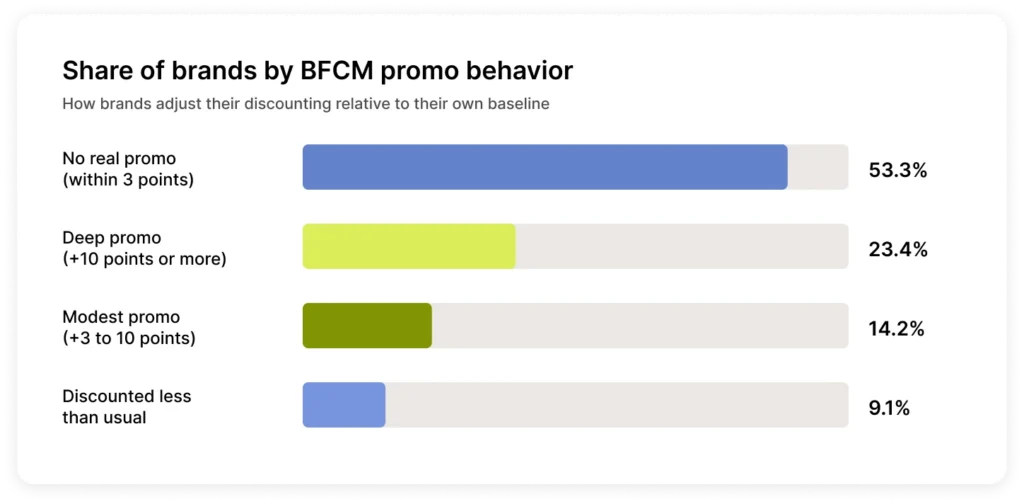
Here’s what brands actually did:
| Behavior vs own baseline | Share of brands | Rest-of-year discount | BFCM discount |
|---|---|---|---|
| Deep promo (+10 points or more) | 23.4% | 10.9% | 30.4% |
| Modest promo (+3 to 10 points) | 14.2% | 9.9% | 16.3% |
| No real promo (within 3 points) | 53.3% | 4.2% | 4.1% |
| Discounted less than usual | 9.1% | 18.3% | 9.0% |
More than half of established subscription brands price Black Friday exactly like any other week, and another 9% actually pull back. Only about a third genuinely promote.
That’s worth sitting with if you’re about to sign off on a 40% discount out of obligation.
These brands aren’t abstaining from discounting. Most of them discount all year, because that’s what subscribe-and-save is. They’ve just decided that Black Friday doesn’t warrant going deeper, and they take the traffic anyway.
How deep is too deep, in general
The Black Friday question sits inside a bigger one we looked at separately: how deep can a first-order discount go before it stops paying for itself?
The short version, from our work on the first-order discount sweet spot, which followed 21 million subscriptions for a full year each and measured every subscriber against the average subscriber at that same brand:
- Up to about 25% off, the subscriber you buy is worth as much as your typical subscriber, sometimes slightly more.
- Between 25% and 75% off, they’re worth a few dollars less over twelve months and renew one to three points worse. You’re paying for a slightly weaker customer.
- Past 75% off it collapses. Those subscribers land 30 to 38 dollars below the brand’s own average over twelve months and renew five to twelve points worse.
So the ceiling isn’t really Black Friday specific. A November promotion in the 20 to 30% range sits comfortably inside the safe zone. What Black Friday changes is what you attach the discount to.
One more thing worth knowing: a first-order discount is now the norm rather than the exception. Just under half of all new subscriptions across Recharge arrive with one, and roughly 89% of those subscribers pay full price on their second order.
For most subscription brands, BFCM is a demand event, not a discount event. People show up whether or not you cut the price. Act accordingly.
This holds true across verticals
The pattern holds in every vertical big enough to measure it.
A majority sit out the deeper discount and the two that promote hardest, Health and Wellness and Pets, are also the two with the strongest underlying retention to absorb it.
| Vertical | Promoted | No real promo | Discounted less | Gap vs own baseline, promoters | Gap, non-promoters |
|---|---|---|---|---|---|
| Health and Wellness | 44.2% | 48.1% | 7.7% | -1.5 points | 0.0 points |
| Pets | 40.4% | 49.7% | 9.9% | -2.0 points | +0.1 points |
| Food and Beverages | 35.1% | 54.6% | 10.3% | -2.1 points | -0.6 points |
| Beauty and Personal | 33.8% | 58.0% | 8.2% | -2.3 points | -0.6 points |
| Home Goods | 33.2% | 58.6% | 8.1% | -2.1 points | -0.8 points |
| Other | 33.1% | 54.8% | 12.1% | -0.8 points | -0.6 points |
| Fashion and Apparel | 27.5% | 61.1% | 11.4% | -1.5 points | 0.0 points |
Two things stand out:
- Fashion and Apparel looks… backwards? Apparel is the loudest category on the whole internet during Black Friday, and here it’s the least promotional of the lot, with one of the largest shares of brands discounting less than they usually do. Those aren’t the same brands. The apparel BFCM you see in your inbox is one-time-purchase retail clearing seasonal inventory; fundamentally different from a recurring apparel subscription.
- Pets brands that didn’t promote came out level with their own baseline, while Pets brands that did promote landed 2.0 points behind theirs. That’s the widest spread anywhere in the data, and it sits in the category with the best Black Friday cohort on the platform.
So what does the deeper discount actually cost?
Now that we can tell a real sale from a standing one, we can price it. Same four groups, but this time we’re asking how their Black Friday subscribers retained at month 13 compared with subscribers that same brand acquired the rest of the year.
| Behavior vs own baseline | Median BFCM m13 | Median rest-of-year m13 | Gap against itself | Brands that came out worse |
|---|---|---|---|---|
| Deep promo | 18.5% | 21.8% | -2.5 points | 66.5% |
| Modest promo | 20.4% | 22.1% | -0.8 points | 55.7% |
| No real promo | 23.1% | 23.5% | -0.4 points | 53.6% |
| Discounted less than usual | 22.3% | 21.1% | 0.0 points | 49.4% |
Brands that discounted deeper came out about two points behind their own normal retention. Brands that didn’t came out level. TL;DR: A deeper discount for BFCM is worthless.
Discounting deeper than your own normal rate costs you.
Of the brands that discounted deeper in November, 67% ended up retaining worse than they normally do. Of the brands that didn’t go deeper, 54% did, which is close enough to a coin flip.
BFCM tip: pull your own rest-of-year discount rate before you set your Black Friday number. You can’t know whether you’re promoting until you know your baseline, and half the market turns out not to be. Your median first-order discount over the last twelve months is the number your November offer should be measured against, not whatever your competitors are advertising.
When should a subscription brand start its Black Friday campaign?
Start it at Thanksgiving and stop it at Cyber Monday. Those five days deliver 12.2% of the new subscribers that arrive across November and December, and they’re the only days in the season when the annual plan really sells. There’s no ramp before them to catch and no tail after them worth chasing.
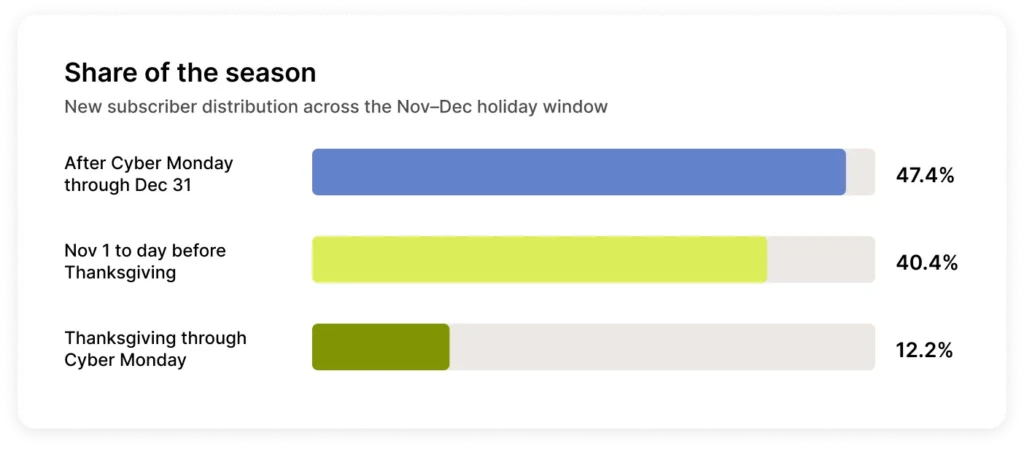
| Window | Share of the season | Annual | Longer than monthly | Avg discount | Active at month 13 |
|---|---|---|---|---|---|
| November 1 to the day before Thanksgiving | 40.4% | 4.7% | 26.6% | 13.1% | 14.7% |
| Thanksgiving through Cyber Monday | 12.2% | 7.2% | 28.6% | 20.1% | 17.1% |
| After Cyber Monday through December 31 | 47.4% | 5.1% | 20.5% | 12.8% | 15.8% |
These retention figures blend every plan type together, so they aren’t the plan-by-plan numbers from the retention section and shouldn’t be compared to them. They describe the quality of what each window brought in.
There’s no ramp before Thanksgiving
This part surprised me.
Daily signups sit at roughly the level of a normal October day right through early and mid November. Thanksgiving itself only runs about 1.1X a normal day. Then Black Friday hits 2.0X and Cyber Monday 1.95X, and within a week of Thanksgiving it’s an ordinary day again.
So early November’s 40.4% of the season looks enormous, but not because anything is building. It’s three weeks of completely normal days. Same for the 47.4% after Cyber Monday, which is five weeks of them. The demand you’re actually planning a campaign around shows up on two days.
Quarterly plans are a November play, annual is a BFCM play
Quarterly plan share barely moves between early November (21.8%) and the five days of BFCM (21.4%). Annual is the plan that cares when you ask: 4.7% before Thanksgiving, 7.2% inside those five days, 5.1% after Cyber Monday.
So if annual is the plan you’re trying to sell, the window is genuinely five days wide and worth concentrating everything into. If quarterly is the realistic upgrade for your product, you have all of November to sell it and you don’t need the discount to do it.
After Cyber Monday the whole mix shortens. Longer-than-monthly falls from 26.6% to 20.5%, and that’s across the largest slice of the season. December still brings volume, it just brings shorter commitments with it.
On timing, most brands already have this right.
Average discount runs 20.1% inside the five days against about 13% on either side, and 58.4% of first orders are discounted against roughly 40%. The concentration is correct. Stretching it is the mistake.
BFCM tip: run the deep offer for five days of BFCM, put it on the annual plan, then switch to quarterly for December. Starting in early November doesn’t catch a ramp, because there isn’t one, and those days convert at your ordinary rate whether you discount them or not. Hold the deep number for Thanksgiving through Cyber Monday, where annual actually moves, then lead December with a quarterly offer, when shoppers are still buying but reaching for shorter terms.
Most of your subscribers will still be month-to-month
Does the data suggest that quarterly and annual plans sold during BFCM are a boon for business? Absolutely.
But volume dictates that the majority of new subscribers you acquire during the holiday will be month-to-month.
71% of them, in fact.
Looking just at monthly plans, here’s how subscribers acquired during BFCM compare to the New Year New Me crowd and the rest of the year:
| Monthly plans only | Reached order 2 | Active m3 | Active m6 | Active m12 |
|---|---|---|---|---|
| Black Friday | 46.8% | 27.1% | 16.5% | 9.4% |
| Rest of year | 43.4% | 24.0% | 14.9% | 8.7% |
| New Year | 40.5% | 22.2% | 13.6% | 8.0% |
Month-to-month BFCM subscribers… kind of crush it.
They don’t beat out the other cohorts by a landslide, but there’s a bump across the board, from order 2 to month 12.
That runs against the premise of the churny deal-shopper.
These people bought during the most heavily discounted week of the year, at a discount that isn’t any deeper than what the brand offers in, say, March, and they stuck around. Whatever the holiday selects for, it isn’t subscriber fragility.
BFCM tip: spend your operational effort on the second order, not the signup. The BFCM monthly cohort already converts to order two better than any other week, so the job isn’t winning more of them, it’s not losing them. Churn in subscription is heavily front-loaded at the first reorder. Have the post-purchase sequence, the upcoming-order reminder, and failed-payment recovery live before the week, not bolted on in December.
BFCM, verticalized
For some categories BFCM produces the best cohorts of the year. For others, the worst.
| Vertical | Black Friday monthly subscriber retention at month 12 | New Year monthly subscriber retention at month 12 | Rest of year monthly subscriber retention at month 12 |
|---|---|---|---|
| Pet | 16.9% | 15.9% | 15.4% |
| Home | 17.9% | 22.2% | 21.3% |
| Health and Wellness | 12.3% | 11.2% | 12.5% |
| Beauty and Personal Care | 7.5% | 9.8% | 10.5% |
| Food and Beverage | 4.7% | 3.5% | 3.9% |
These are monthly subscribers only, and the figures in the table show the share of BFCM subs still active twelve months after signing up.
Higher is better (duh).
Categories retain at very different absolute levels, so what matters is how a category’s Black Friday number compares with its own January and its own rest of year, not with another category’s.
Depending on your vertical, you’re going to take one of three paths: double down, hold steady, or pivot.
Pet: double down, and double down on plan length
Pet has the best Black Friday cohort of any category and beats its own rest-of-year average, which almost nothing else here does. The reason is unglamorous. The dog still needs feeding in February regardless of why the subscription started in November, so the product has a floor under it that supplements and skincare don’t.
Pet is also where the discount is least necessary: Pets brands that promoted deeper came out 2.0 points behind their own baseline while the ones that didn’t came out level. You’re paying for demand you were going to get anyway.
The play: go hard on volume and hard on annual, and keep the discount near your normal rate. If you’re going to spend anything, spend it on a bigger first shipment rather than a deeper cut.
Food and Beverage: double down on the week, change what you sell
Food and Beverage has the weakest absolute retention on the platform at 4.7% active at month 12, and Black Friday is still its best acquisition window, ahead of both January and the rest of the year.
Both things being true at once is the whole problem. BFCM, but it’s pouring subscribers into a leaky bucket, so raw signup volume is close to worthless as a goal here.
The play: sell the quarterly. At a 4.7% twelve-month rate on monthly, the only lever with real upside is making the commitment longer at the point of sale, because you won’t fix the leak between now and February.
Health and Wellness: hold steady, and trade volume for mix
Health and Wellness comes in at 12.3% 12 month subscriber retention against 12.5% for the rest of the year. No penalty, no bonus, which makes it the cleanest category to run an experiment in.
The play: stop optimizing BFCM for signup count, since more signups just means more of exactly what you already get. Optimize it for plan mix instead. This is also the category growing fastest going into this November, so the volume will come whether you chase it or not.
Beauty and Personal Care: hold steady, and budget for the drop
Beauty is the clearest cautionary case, at 7.5% 12-month subscriber retention against 10.5% the rest of the year. November buying skews gift and deal-hunt here more than anywhere else, and the cohort behaves accordingly.
The play: run Black Friday, because the volume is real, but forecast a weaker cohort in your model rather than discovering it in March and assuming something broke. Beauty is also heading into this November with less traffic and deeper discounting, which is the wrong combination for the category least able to carry it.
Home: pivot to January
Home is the one category that should arguably sit Black Friday out, or at least not lead with it. It lands at 17.9% 12-month subscriber retention against 22.2% in January, the widest gap in the dataset and the only category where New Year clearly beats the holiday.
The play: if you’ve got budget for one promotional push, spend it on New Year. Home purchases follow moving, renovating, and resetting the house, and those happen in January.
BFCM tip: find your category and decide which of the three paths you’re on before you build the offer. Pet and Food and Beverage double down. Health and Wellness and Beauty hold steady, for opposite reasons. Home pivots to January. Same week, opposite plans.
How to plan this year’s Black Friday / Cyber Monday
BFCM is five days that reliably deliver more new subscribers than any other five, and about 2.4% of everything you’ll acquire all year. Planning it as though it will make or break your year is what produces the 40% offer nobody needed.
The decision that actually moves your retention is which plan you attach the discount to, not how deep you cut. We track these shifts year-round in the Subscription Trend Report.
About this report
These figures come from Recharge platform data covering subscription brands selling on Shopify.
BFCM here means Thanksgiving through Cyber Monday, five days, calculated for each year rather than fixed to a set of dates. Platform-wide figures cover 2021 through 2025. The discount-band retention figures use 2021 through 2024 and the promotional-behavior analysis uses 2022 through 2024, both of which need thirteen months of history behind each cohort. The plan-by-plan retention curve stops at 2023, because its month-24 column needs two full years and the 2024 cohort does not reach that until this November. The monthly-only cuts are 2022 through 2024, and the year-on-year comparison runs January 1 to September 10 in both 2025 and 2026. The season-by-window cut, which splits November and December into early November, the five days, and everything after Cyber Monday, also uses 2022 through 2024, and its five-day row reproduces the plan-mix figures above exactly, which is how we know the two are measuring the same week. The daily signup curve uses 2021 through 2025, indexed within each year against that year’s average October day.
Retention is measured by time rather than order count, meaning whether a subscriber is still active at a given month. Cohorts too young to have reached a milestone drop out rather than counting as churned. Month 13 is used for annual plans because month 12 lands mid-renewal. Order-count comparisons are avoided throughout, because order 12 means twelve months on monthly and twelve years on annual. Plan-mix figures count only subscriptions billed monthly, quarterly, or annually; other billing intervals are excluded rather than bucketed.
Promotional behavior is measured per brand against that same brand’s own rest-of-year discount rate, across 3,232 brands measured in November 2022, 2023 and 2024, for 5,715 measurements in total, since a brand that qualified in more than one year is counted once for each. Discount figures start in 2021, because coverage before that is too thin to compare, and are capped at 50% off.
Gifting can’t be measured directly, so the gift figures use a proxy: orders where the billing address and the shipping address don’t match. Those come from a stable set of consumable brands in food and beverage, health and wellness, pet, and beauty and personal care that have been active since before 2024, pooled across 2024 and 2025. The proxy catches second homes, work addresses and recent movers alongside real gifts, so the level overstates gifting. The comparison between windows is the part that holds, and the December lift is what shows the measure detects gifting at all.
Every figure is aggregated across brands. No individual merchant is identifiable in any table here.
Brands that choose to discount deeply may differ from those that don’t in ways this data can’t see. The relationship between deep discounting and weaker retention is a consistent association across five years, not a proven cause.
Frequently asked questions
Yes, and for a reason most operators miss. It’s the one week shoppers reach for longer plans, and those subscribers retain far better. Brands that don’t discount deeper than usual get a November cohort as good as any other month’s, plus the extra volume.
Not because of the date. On monthly plans, BFCM subscribers beat both January and the rest of the year. Where retention does slip, it tracks how deep the brand discounted rather than when it acquired.
Deep enough to matter, but spend the margin on plan length first. Discounting deeper costs the typical brand about two points of month-13 retention. Moving a subscriber from monthly to annual is worth far more than that, even at half off.
No. BFCM’s share of new subscriptions has risen every year we have clean data for, from 1.88% of the year’s signups in 2021 to 2.38% in 2025, and the week now delivers about 2.4% of annual subscriber acquisition from 1.4% of the calendar. It’s a growing share of a growing number.
Categories

Related articles
Explore additional content that complements what you’ve just read.
The quarterly upgrade: subscription retention’s most underused lever
CPG product sampling: why a $0.99 intro offer retains subscribers nearly 4× better than a free one
The first-order discount sweet spot for CPG subscription brands is deeper than you think

Ask your store anything, get the answer from Remi
There’s a fresh wave of pet-food M&A, and the subscription data shows what’s actually worth the premium