
The first-order discount sweet spot for CPG subscription brands is deeper than you think
Published July 2026
Published Jul 2026
Updated August 2026
Updated Aug 2026
11 min read
AI Summary
The first-order discount sweet spot sits under 25%, with room to about 60% before it bites. Based on data from 20,000+ subscription brands.
On the Sweat Equity Podcast, operator Brian Blum breaks down how he engineers a first purchase to stick:
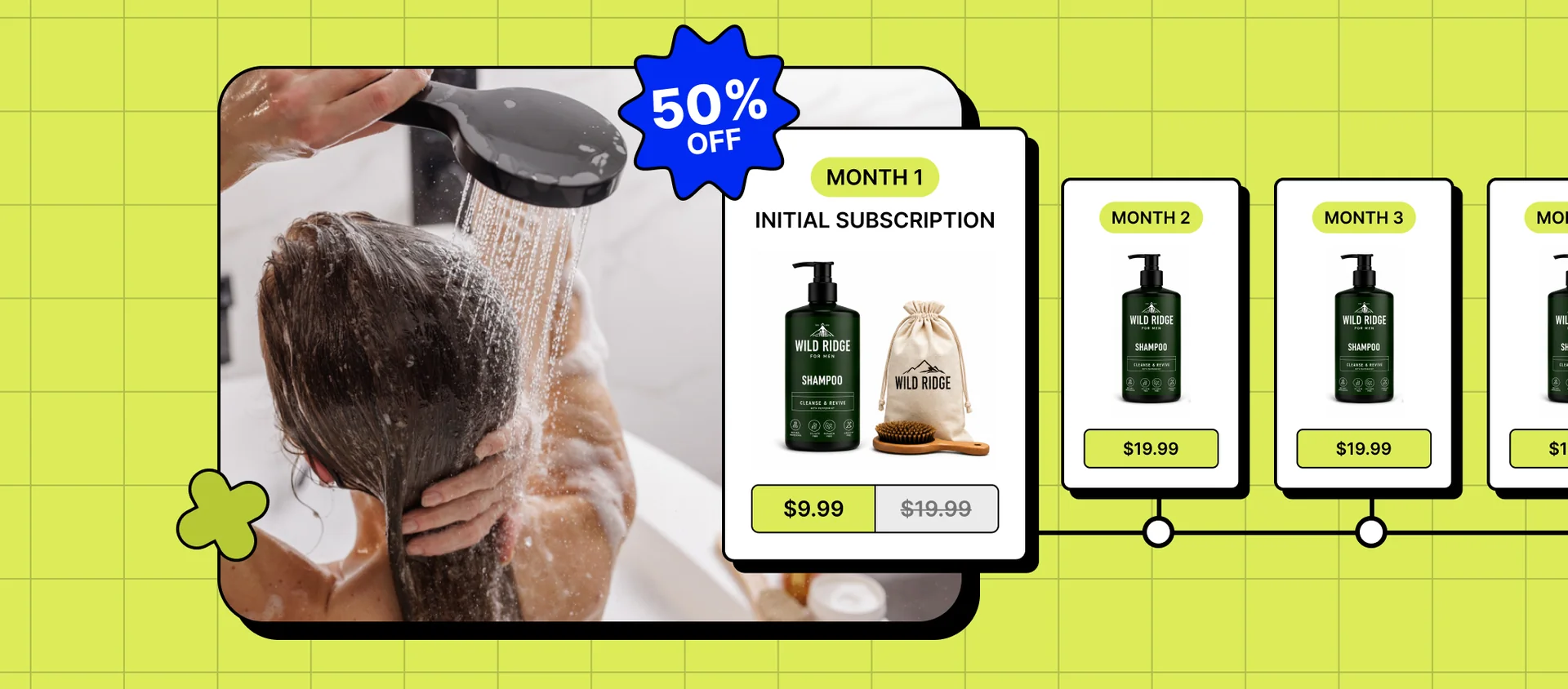
- hand it to the customer at 50% off in month one (STEEP discount)
- engineer buy-in through killer unboxing (onboarding gifts, education)
- charge full price on the first renewal
It’s a sharp, deliberate playbook. And it’s widely used across the subscription CPG space. But how deep can that discount actually go before you’re buying subscribers who leave when it’s time to pay full price?
We measured first-renewal rate across 29.8 million new subscriptions to find out.
tl;dr a subscriber you acquire at up to ~25% off is worth as much over 12 months as that store’s own typical subscriber. From 25% to 75% off, each acquired subscriber is worth a little less. Past 75% off? The value falls off a cliff.
Here’s why.
First order vs. first rebill: the two prices that matter
Every subscription has two prices, and the delta between them, the discounted first order versus the full-price rebill, is where you find out whether a signup became a subscriber.
The first order. A (sometimes heavily) discounted welcome. The offer that gets someone to sign up.
The first rebill. The first automated payment. The first time a subscriber is asked to pay full price (the price they’ll pay in subsequent rebills, too).
Discounting the first order is extremely common: nearly half of new subscribers, 48% to be precise, are acquired with some form of discount. And it’s almost always temporary. Nine times out of ten, when those subscribers place a second order (first rebill), it steps back to full price. The discounted welcome is an acquisition offer, not a standing price.
That second price is where subscriptions are won or lost.
A signup is a maybe, a tire kick. A first rebill is a subscriber (the best kind of customer). So the number that matters isn’t how many people took the discounted offer, it is first-renewal rate: the share of new subscribers who come back and pay for that second order.
First-renewal rates fall as acquisition offer discounts deepen
A new subscriber paying full price sticks around past the first rebill about 65% of the time.
| First-order discount | New subscriptions | First-renewal rate | Median first order |
|---|---|---|---|
| None | 12,102,567 | 65.0% | $37.60 |
| Under 20% | 5,215,711 | 64.7% | $39.72 |
| 20 to 40% | 5,885,714 | 62.9% | $33.05 |
| 40 to 60% | 3,094,674 | 61.3% | $28.46 |
| 60 to 90% | 406,152 | 60.0% | $12.42 |
| 90%+ (near-free) | 1,526,365 | 53.4% | $0.02 |
And even with a steep 40 to 60% first order discount, that renewal rate only slips to 61%. This tells us that moderate promotions are close to retention-safe. This is why a steep first order discount, the kind Brian runs, falls just outside of the danger zone.
The sharp drop comes, however, when you basically give your intro offer away for nothing. Subscribers acquired at 90% or more off list price renew at just 53.4%. Yikes.
What a deep first order discount actually breaks
A monster first order discount does more than attract deal-seekers. It sets the wrong anchor. Someone who joins at 80% off has priced the product in their head at the discounted number, so the first full-price rebill reads as a price hike rather than a renewal.
Nothing changed about the product, but the gap between what they paid and what they are now asked to pay is the moment a lot of them quit.
The deeper problem is timing. Most subscription payoffs, whether a supplement that takes weeks to work or a routine that has to become a habit, haven’t landed yet when the second charge arrives. The subscriber is asked to pay full price before they’ve felt the benefit; the value gap is widest exactly where the discount was deepest.
So what’s the fix? You need to close the expectation gap and the price gap.
Set expectations early so the subscriber knows when the benefit arrives and doesn’t give up. Build enough affinity in the first order so the second feels like continuing a habit rather than overpaying for snake oil.
It’s the discount, not the brand: a same-store control
It really is the discount, not the brand. Inside the same store, a deep first-order discount (60% or more off) retains about 9 points worse than a shallow one, and 71% of the 350 stores we could check show it on their own customers.
We wanted to know whether this was a discount problem, a brand problem, or both. Weaker brands tend to discount harder, so the gradient could just be a story about which brands land in each bucket.
So we looked at 350 stores that offer a variety of new subscriber acquisition discounts. Here’s what we found.
| Within-store control | Value |
|---|---|
| Stores qualifying | 350 |
| Weighted first-renewal, low discount (under 20%) | 64.1% |
| Weighted first-renewal, deep discount (60%+) | 55.1% |
| Mean within-store gap (low minus deep) | 11.1 pts |
| Median within-store gap | 8.0 pts |
| Stores where deep-discount retains worse | 248 of 350 (71%) |
That gap is inside the same brand, on the same products, in the same window, which is what points at the discount itself rather than the mix of brands.
So what’s the ideal first-order discount for CPG subscriptions?
A first-order discount at or below 25% off results in a subscriber worth as much to your brand as one who paid full price from the jump. But a subscriber with a first order discount of 75% or more is worth $30-38 less.
Now a caveat: Brands are wildly different. A typical subscriber at a premium supplement brand is worth far more than one at a budget coffee brand, and the brands that lean on deep discounts tend to be different businesses than the ones that sell at full price. So comparing discounted subscribers across brands mostly tells you which brands discount, not what the discount actually did.
The fix is to compare each brand only to itself.
For every store in our dataset, we line up its discounted subscribers against that same store’s own average subscriber, then look at the pattern across all of them. It’s the difference between judging a kid’s height against every school at once and judging it against their own classmates.
The table below is that same-store comparison: for each discount band, how much more or less a subscriber is worth over 12 months than their own store’s typical one.
| First-order discount | 12-mo value vs the store’s own average sub | First-renewal vs the store’s own average |
|---|---|---|
| None | +$7.03 | +2.5 pts |
| 1-10% | +$9.58 | -0.5 pts |
| 10-25% | -$2.32 | -1.0 pts |
| 25-50% | -$8.48 | -3.4 pts |
| 50-75% | -$4.76 | -1.1 pts |
| 75-90% | -$38.03 | -12.0 pts |
| 90%+ | -$30.33 | -4.9 pts |
Read it as four zones.
- Up to about 10% off, the subscriber is actually worth a few dollars more than the store’s no-discount subscriber. Weird.
- From there to 25% off, it is basically a tie.
- From 25 to 75% off, a little worse.
- Past 75% off the floor drops out: those subscribers come in 30 to 38 dollars below the store’s normal subscriber and renew 5 to 12 points worse.
So the sweet spot is less than 25% off, where the discount still buys you a subscriber as good as the ones you get at full price. The reassuring part is how gentle the middle is: from full price to 75% off you stay within a few dollars of your own normal subscriber, and the value only really drops out at the near-free end. A steep welcome like Brian’s 50% is a reasonable call, not a mistake.
Note: This is value per acquired subscriber. Recharge sees retention and realized value, not your acquisition volume, your CAC, or your margin. A deeper discount can still pay off if it brings in enough extra subscribers to cover the lower value each one returns. The point is not that discounts are bad. It’s that past a certain depth you’re paying for volume, not for customers who stay.
What to do with this on your own store
Default to a first-order discount under 25%, but treat a steeper welcome, up to about 60% off, as a fair trade rather than a business-derailing mistake. Track first-renewal by discount band, not revenue.
- Aim under 25%, where each subscriber pays for themselves. But do not fear a steeper welcome. The penalty stays small and flat up to about 60% off, so a 40 or 50% intro, the kind my guy Brian runs, is a fair trade for volume rather than a mistake. The one line to hold is the near-free end: past 75%, and especially 90% or more, is where the subscriber you buy is worth far less and leaves faster. Wherever you land, step the discount down on later orders instead of running one flat deep price.
- Use deep discounts deliberately, not by default. A launch moment or a box model built for it can carry a steep offer, especially when you wrap it in the gifts and expectation-setting that keep a subscriber engaged. Cohort-track those campaigns so you see the renewal cost, not just the signups.
- Watch first-renewal by discount band. If you can see first-renewal by cohort, you can catch a failing discount in weeks instead of quarters, and keep more of the subscribers you paid to acquire.
- The catch for many teams is visibility. If your platform only shows aggregate revenue and gives you a single flat discount to work with, you cannot run this loop at all. That is a platform limitation, not a you problem.
Pull your own first-order cohorts, split them by discount depth, and check where your money is actually made. The pattern in Recharge’s subscription data is consistent across tens of thousands of brands, but the version that matters is yours.
How the best subscription brands make a steep first order discount work
A steep first-order discount only pays off if you close the value gap before the rebill. The discount decides who you acquire; the first 90 days decide whether they stay. In the same Sweat Equity breakdown that incited this data dump, Brian walks through the retention side of a deep acquisition offer (and presents a few moves worth stealing).
Engineer the unboxing as expectation-setting
Tell the subscriber what to expect at day 30, 60, and 90, so when the product takes time to work they know the payoff is coming and do not cancel at day 45. The first box is where you set the timeline that carries them past the first rebill.
Layer in (affordable!) memorable gifts
Brian’s rule is to not lose the farm on it: gift small, useful items that cost cents but stick around, like a co-branded frother or a simple sleep mask. He cites Everyday Dose (Skio customer!), whose little co-branded goodies sat on the counter and kept the brand top of mind even for people who never used the product.
Protect the rebill
The whole model depends on that second charge going through, so the reminder and email sequence around it is not optional. A subscriber who forgot they signed up churns at the rebill no matter how good the product is.
Borrow someone else’s value
Brian points to partnerships with adjacent apps, like a calm or breathwork app giving your new subscribers a free first month, so the first box carries value you did not have to build yourself.
None of these lower the discount. They close the value gap the discount opens, which is what lets a steep offer pay off.
Conclusion
There’s one way to dodge this tension entirely: never charge your subscribers full price. About .5% of brands we analyzed do essentially that, discounting nearly every rebill.
For every other brand, the job isn’t avoiding the full-price rebill but bridging to it, closing the gap between the discounted first order and the moment the subscriber pays full freight with expectation-setting education and a killer brand experience.
So treat the first-order discount as an acquisition-quality dial, not a free growth lever. Aim under 25% when you can and treat a steeper welcome as a fair trade rather than a mistake.
About this report
These figures come from two cohorts of Recharge subscribers, all actively selling subscriptions on Shopify.
First-renewal by discount depth is measured across roughly 29.8 million new subscriptions whose first order was paid between July and December 2025, with renewal tracked through June 30, 2026. The 12-month value curve comes from an earlier cohort, roughly 21.0 million subscriptions first paid between July and December 2024, each followed for a full year. The ideal-discount reading is taken from the store-demeaned version of that cohort, about 19.5 million subscribers at stores with at least 100 subscriptions across several discount bands, so brand composition cannot skew it.
Every figure is aggregated across brands, and no single merchant is identified. A few caveats worth keeping in view: discount fields carry some upstream matching noise, so the band boundaries are approximate, the 90%-plus tier is dominated by essentially-free first orders at a median of 2 cents, and the relationship is a strong association rather than proven causation.
Frequently asked questions
On Recharge’s data, an offer under about 25% off keeps the subscriber worth as much as a store’s typical one over 12 months. Past 75% off, value drops sharply.
Only at the extreme. First-renewal is roughly flat down to about 40% off, then falls hard at free and near-free first orders.
The worst-retaining cohort bills almost nothing on the first order, so it is close to invisible in a revenue total. First-renewal rate by discount band surfaces it.
Categories

Related articles
Explore additional content that complements what you’ve just read.

Inside ChargeX East: How the best brands are driving retention in the agentic era
2026 Black Friday marketing strategy for subscription brands
The quarterly upgrade: subscription retention’s most underused lever
CPG product sampling: why a $0.99 intro offer retains subscribers nearly 4× better than a free one
There’s a fresh wave of pet-food M&A, and the subscription data shows what’s actually worth the premium