Let’s start with the truth no one wants to say out loud:
Every subscription brand must treat the first 30 days as an extension of its product!
And because most brands don’t, they end up having a massive belief problem.
What is a ‘belief problem’, you ask?
Well…
If buyers don’t believe your product will work for them – in their real life, with their real habits, etc. – they will churn long before price, convenience, or timing ever enter the conversation.
And this belief (or lack of it) is shaped almost entirely in the first 30 days.
But very few operators understand how early churn looks.
In this guide, we’ll break down the principles from Retention Economics that explain why the first month determines your entire LTV curve and how to use Recharge’s ecosystem to engineer belief, momentum, and habit-building from Day 0 to Day 30.
Let’s dive in!
Belief-Engineering, Not Just Box-Shipping
An early mentor of mine once told me:
“Price isn’t the enemy – doubt is.”
If you strip away the excuses customers give when they cancel (“too expensive,” “have too much product,” “not sure if it’s right for me”), you always find the real reason underneath: They didn’t believe the product was going to help them enough to stay subscribed. They couldn’t justify paying for an extra month, and they churned.
This is the truth for most brands that treat the first 30 days as “we just need to ship the freakin’ box.”
(Or, even worse, they totally ghost the new subscriber, hoping they forget they’re on a subscription and renew accidentally – yikes!)
Compare this with 15 category-defining, fast-growing 8- & 9-figure CPG brands I’ve worked with: They spend the first post-purchase 30 days engineering belief.
Specifically, they focus on two key post-purchase windows:
1. The Pre-Delivery Window (New Subscription → Delivery)
Because they may have clicked “Buy”, it doesn’t automatically make them loyal customers. Pre-delivery is the danger zone where:
- Skepticism creeps in
- Anticipation turns into anxiety
- Buyers second-guess their purchase
- Silence from the brand feels like abandonment
First-time buyers are wrestling with five early unspoken objections:
- Is this right for me?
- Is it worth the money?
- Can I trust this brand?
- Are the claims believable?
- What are my other options?
If you don’t proactively answer these, you’re increasing the chances of refund requests, delivery-time churn, and non-usage.
And that’s why most brands lose retention before the box even lands.
2. The Post-Delivery Adoption Gap (Delivery → Day 14)
Once the product arrives, another trap opens up:
Lack of onboarding → lack of belief → lack of usage → lack of results → churn
If buyers don’t know:
- How to use the product,
- When to use it,
- How much to use,
- What results to expect,
- And when to expect them,
…they naturally default to inaction.
And an unused product has a 0% chance of renewal.
The solution?
Belief-Engineering:
“Belief Engineering is a structured 30-day experience that turns a first-time subscriber into someone who trusts the product, uses the product, and feels the product’s early benefits – long before their first renewal.”
When belief goes up, churn drops, LTV grows – and everything else becomes easier.
And the key metric that tracks your belief-engineering success…?
Read on.
Why the 30-Day Repurchase Rate Is Key
A strong 30-Day Repurchase Rate can reshape your entire business.
Let me share a quick case study from the book Retention Economics:
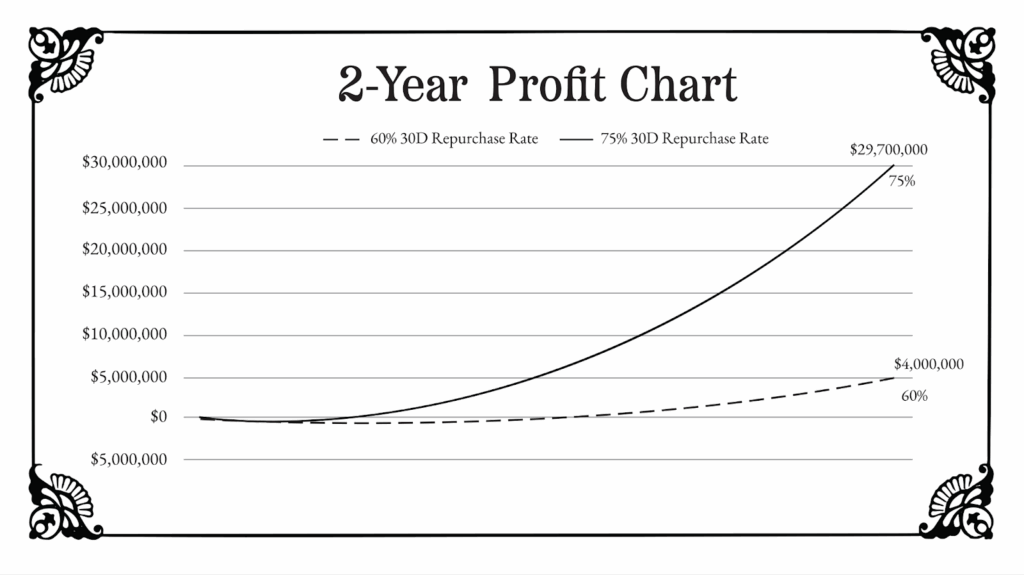
This brand has a healthy 3-month Payback Period, with their 30-Day Repurchase Rate (Month 1 to Month 2) at 60%. Now, if the same brand hits 75% – with everything else staying exactly the same – that single-point improvement sends profits compounding. Based on my simulator, 2 years later, they’re 7.5x higher! And the Payback Period is now 2 months (instead of 3).
See the massive difference? It’s worth repeating:
+15 percentage points in 30D Repurchase Rate = 7.5x more profit in 2 years!
75% = profit-compounding, market share thief.
60% = side player, trapped in stagnation.
See the graph below.
That’s why, when I work with a new client, I always optimize their 30-Day Repurchase Rate first.
The “waterfall effect” on LTV is real:
If more people buy again in Month 1, more people remain eligible to buy in subsequent months, such as Month 2, Month 3, and Month 4, and so on.
Effectively, the 30-Day Repurchase Rate becomes your #1 profit multiplier.
It compounds your Net Revenue.
It makes CAC pay back faster.
It boosts your LTV:CAC ratio.
And most importantly, it buys you leverage – the kind that lets you scale without constantly chasing new buyers…the expensive, flaky ones.
A Playbook for Day 0–30
Ready for some action?
Here’s your 3-phase framework for belief-engineering, onboarding, and superior 30-Day Repurchase Rate.
Phase 1: Pre-Delivery (Day 0 → Delivery)
Goal: Eliminate doubt before it forms.
Here’s your playbook:
- Don’t go silent! Send post-purchase emails to kill the five unspoken objections we mentioned above.
- Craft text-based, personal-looking messages from the founder or key member of the brand (not flashy HTML showcases of the brand) for maximum engagement and primary inbox placement from the get-go. (CRUCIAL)
- When the enthusiasm is at its peak, collect Zero-Party Data to personalize their customer journey down the line. “What is your primary goal?” or “What problem do you want to solve with the product?” is always my #1 question.
- Offer a series of freebies to strengthen the perceived value of their purchase and build their pre-delivery enthusiasm.
- Get them on your SMS Club with an irresistible promise – SMS always converts better than email.
- Keep them updated about the progress of their order to reduce CX “where is my order?” tickets and build trust.
You only have 4-5 days for all the above! But the psychology is simple:
When you provide a lot of upfront value and care before they even receive their order, you shift them from skepticism to belief.
You’re not just warming them up – you’re pre-seeding the second purchase.
Phase 2: Post-Delivery (Day 1 → Day 14)
Goal: Onboard the buyer and create early wins.
This is the most dangerous part of the journey – the Adoption Gap.
If your new buyer doesn’t use your product soon, chances are they will churn before the rebill.
To win here, you need:
- Clear usage instructions
- “Quick-win” milestones
- A founder-first check-in
- Usage frequency reminders
- A celebratory “first win” message
This is where the concept of Bite-sized Premium Masterclasses (BPM) comes in.
Each BPM:
- Is fun & interactive
- Lasts under 2 minutes
- Teaches 1 specific benefit
- Offers a quick, feel-good reward at the end
These micro-lessons reinforce perceived value & drive adoption.
This phase is especially critical in health & wellness, beauty, and overall CPG brands, where perceived benefits often lag behind real ones.
That’s why you need to engineer these early quick wins. Because the faster you help them feel something, the more likely they are to stay.
If you guide buyers through their first 7–14 days, you can cut your cancellation rate dramatically.
Phase 3: Repurchase Runway (Day 15 → Day 30)
Goal: Guide buyers to their first renewal – or early repurchase.
The final stretch is about overcoming the “Month 1 churn wall.”
Here’s what works:
- Running-low reminders
- Early renewal incentives
- Personalized cross-sells
- A simple 3-month bundle upgrade offer
But my favorite?
The ‘Billing Reminder Reframe’.
Most brands say, “Your card will be charged in 3 days.” This approach triggers cancellations galore. Instead, include a freebie in their second order and reframe it as:
“Your next FREEBIE ships in 3 days.
We’ve got a surprise waiting in your next box.”
This shifts the mental frame from money loss to value gain. This future-pacing hack alone can reduce your billing reminder churn by half.
Recharge gives you all the levers for this phase:
- Quick actions
- Product add-ons
- ‘Get order early’ prompts
- Skips/pauses (to avoid full churn)
- Swaps (to maintain belief instead of losing the buyer entirely)
And that’s how you move subscribers past Month 1 – where real retention begins.
Conclusion: If You Fix Your 30-Day Repurchase Rate, Everything Else Compounds.
There’s obviously a lot more nuance and many more actionable strategies to increase your 30-Day Repurchase Rate, so Recharge recommends picking up Retention Economics or speaking to Thomas Lalas directly.
The brands that scale on Recharge aren’t the ones with the most aggressive offers or clever upsells – they’re the ones who treat the first 30 days as the core of their product.
- Transparency, not ghosting.
- Belief-engineering, not box-shipping.
- Daily onboarding, not one-off transactional emails.
Win the first month, and you win the subscription for the long run.