
Customer data collection: It’s a process that can either make you an ecommerce genius or turn you into a laughingstock. We have all questioned someone presenting data, whether the data was egregious, inconclusive, or based on false data collection.
Let’s explore some of the right and wrong ways to collect data from your customers and how to use that data to market, inform, and convert for ecommerce.
The wrong ways to collect data
The invasive inquirer
Picture this: You receive an email from a company asking for your shoe size, your favorite color, and your deepest, darkest secrets. Yikes! Remember, there’s a fine line between personalization and prying. Respect your customers’ privacy and only request relevant information.
The never-ending form
Imagine stumbling upon an ecommerce website with a data collection form that feels like an endless abyss—asking for your name, age, occupation, mother’s maiden name, pet’s name, and so on. Keep it concise, people! Nobody wants to spend an eternity filling out a form. Keep the questions relevant and snappy.
Also: What do you intend to do with the information? Make sure you’re taking action on anything you ask for in a relevant way. If the reason why you’re asking for it isn’t obvious, explain it briefly on the form for customers.
The aggressive harasser
You’ve just made a purchase, and the next thing you know, you’re bombarded with a never-ending stream of emails, texts, and carrier pigeons. Take it easy, bud! Avoid becoming a data collector turned digital stalker. Respect your customers’ boundaries and give them space to breathe.
The right ways to collect data
The “value-for-value”approach
Provide customers with a clear and concise explanation of why you’re collecting their data and how it will benefit them. Offer exclusive discounts, personalized recommendations, or relevant content tailored to their preferences. Make it a win-win situation!
Ask for permission, not forgiveness
Ask for permission! Nobody likes unwelcome surprises, especially when it comes to data collection. Ensure your customers explicitly give their consent before gathering their information. Transparency should be your love language.
Everyone likes a good game
Turn the data collection process into an interactive and entertaining experience. Create quizzes, contests, or fun surveys that customers can’t resist participating in. Inject some humor and creativity to make it an enjoyable journey for everyone involved.
From data to dollars—best practices for customer data
Personalization is only kind of a buzzword
Once you have collected data, use it wisely! Tailor your marketing campaigns based on customer preferences, buying patterns, and demographics. Create personalized product recommendations and offers that make your customers feel like you read their minds.
Also, remember not to make assumptions and alienate half your audience or half your product catalog. Knowing someone is male or female may be helpful on an engagement ring site, but will it really be helpful if you are selling pet food? We see too often people coming to shop for one thing, being categorized as a certain kind of person, and then never being introduced to all the business has to offer. There is no need to over-segment!
Timing is everything
Analyze the data to determine the best moments to reach out to your customers. Don’t pester them with offers at 3 a.m. or during their favorite TV show. Use the data insights to send timely and relevant messages that align with their routines and interests.
Quantitative data usually doesn’t supply any answers
Lastly, remember that data alone won’t magically convert customers into buying machines. Combine your data-driven strategies with captivating storytelling, exceptional customer service, or a sprinkle of humor.
The numbers in your dashboard may tell you who is converting and who is not, but they are not going to tell you why or how. Build genuine connections with your audience, gather qualitative data like a fiend, and the conversions will follow suit.
Get the most value out of your customer data
Data collection in the world of ecommerce can be treacherous, but with the right approach, it can be a goldmine for marketing, informing, and converting customers. Avoid the blunders of invasive questioning and overwhelming forms, and instead, embrace the delights of transparency, gamification, and personalization.
Remember, data is a powerful tool, but it’s your creativity and finesse that will truly make your ecommerce efforts shine. Care about your customers in a genuine way, and doing things “right” will be easy.
At Recharge, we value privacy and handle personal information accordingly. Learn more about how we handle personal information by reviewing our Trust Center.
Our annual ChargeX conference is always a high point in the year, and 2023’s event last week was no exception.
ChargeX Beyond was all about looking ahead and reimagining a more robust future with the best and brightest minds in ecommerce. Hundreds of merchants, partners, and colleagues came together in Washington, D.C. for three days of storytelling, learning, and in-person connection.
Missed the conference this year—or just want to relive the details? You’re in the right place. We’ve got the full event recap, including speaker highlights, industry insights, and details on next year’s event.
Merchants that go beyond
We kicked things off on Wednesday evening with a welcome reception. A highlight of the night was our Merchant Gallery, a museum-style showcase spotlighting eight Recharge merchants whose purpose goes beyond their products.

All of the featured brands—Blueland, Bobbie, Bite, Who Gives a Crap, Early Majority, Blume, Tea Drops, and Bird&Be—are dedicated to making a difference in both their customers’ lives and our society as a whole. And each one embodies the spirit of the beyond event theme—helping us set an intention for the rest of the conference.
Opening remarks & the Recharge product roadmap
After we recounted moments from the previous evening and reconnected with old friends, Thursday’s sessions began with a welcome keynote address. Recharge CEO Oisin O’Connor walked us through the three stages of ecommerce our world has seen thus far: The Start, The Scale, and—our present state—The Mature Phase.

In today’s world, Oisin noted, being a resilient business reigns supreme. Now more than ever, businesses are looking for ways to streamline their operations, foster loyalty among their customers, and create sustainable practices.
Oisin was joined by Erin Carey, Recharge’s Senior Director of Product & Customer Marketing, who spoke about how brands can incorporate “cornerstone moments” into their shoppers’ journey to increase engagement and retention.
Jordan Bluhm, Recharge’s Principal Product Manager, then walked through the Recharge product roadmap, announcing several major upcoming releases—Bundles, Memberships, and Rewards—that will enable merchants to maximize the value of their customers.
Finally, Wesley Magness, Research & Development at Recharge, walked us through Flows, the glue that holds Bundles, Memberships, Rewards, and Subscriptions together with automations for surprising and delighting customers throughout their journey.
From sign-up to staying power: Strategies for retaining subscribers from Chris George
Next, Chris George, Co-Founder of the acclaimed SubSummit subscription commerce, talked through his strategies for retaining subscribers in today’s market.
These days, Chris noted, many customers don’t feel loyal to brands due to factors like poor product quality, negative customer service experiences, and lack of personalization. The key, he said, is to focus on listening to your customers and what they’re obsessing over—then bring this back to your brand to do something about it. For subscription brands, he observed, the stakes are especially high, as you’re not just competing within your own vertical, but also with other subscription brands.
Insider expertise from merchants & partners
Thursday afternoon brought a wealth of breakout sessions organized around different themes.
On the partner track, Brandon Amoroso, Founder of Electriq Marketing (a DRINKS company) kicked things off on the main stage with a talk on building a retention program for your merchants. Afterward, Adam Pearce and Peter Gardner of Blend Commerce discussed agency and tech partner strategies to help merchants grow LTV and better understand their customers.
On the merchant track, attendees could choose from a multitude of sessions. Topics ranged from psychology-based advertising techniques to strategies for personalizing the buying experience with customer data.
Lending their expertise to each session were industry leaders from PrettyLitter, Bokksu, Vegamour, Blueland, HelloBello, KnoCommerce, Friendbuy, Chelsea & Rachel Co., Open Farm Pet, Absolute Web, Rebuy, Sticky Digital, Wandering Bear Coffee, Primal Kitchen, Uqora, Churn Buster, Alpha Omega, Praella, and Scoutside.
Merchant & Partner award winners
ChargeX 2023 marked our first ever Merchant & Partner Awards, where we honored exceptional members of our ecommerce community. And the awards went to…
Partner Rising Star Award: Vaan Group
Our Partner Rising Star Award recognizes a Recharge partner who is investing in growing their subscription business with Recharge and taking the steps to proactively build their business for both immediate and long-term success. Congratulations to our winner, Vaan Group!
Amplifier Award: Gorgias
The Amplifier Award recognizes the Recharge technology partner whose integration and engagement has added significant value for Recharge merchants. Congratulations to our winner, Gorgias!
Agency Partner of the Year Award: Electriq Marketing
The Agency Partner of the Year is our top partner award, recognizing the Recharge agency partner who led the pack over the last year in terms of engagement, merchant focus and execution. Huge congratulations and appreciation to Electriq Marketing!
Merchant Rising Star Award: ModifyHealth
The Merchant Rising Star Award recognizes a new(er) Recharge merchant who experienced a high level of growth in 2022. Congratulations to ModifyHealth!
Holiday Highlight Award: Clearly Filtered
The Holiday Highlight Award recognizes the Recharge merchant who achieved the most impressive results over Black Friday/Cyber Monday. Congratulations to Clearly Filtered!
Merchant of the Year Award: Crunch Labs
The Merchant of the Year is our top merchant award, recognizing the merchant who exhibited best overall performance in 2022. Congratulations to Crunch Labs!
Beyond Award: Bobbie & Presidio Creative
And finally, The Beyond Award recognizes both a Recharge partner and merchant who implemented a program or project within Recharge that goes above and beyond out-of the-box capabilities. A huge congrats and thank you to Bobbie & Presidio Creative!
To innovation & beyond with Matthew Luhn

An expert at crafting narratives and creating vibrant characters, Matthew Luhn is a Pixar-credited author and storyteller whose credits include the Toy Story films, Monsters Inc., Finding Nemo, Cars, Monsters University, Ratatouille, and UP.
His keynote speech focused on how merchants can use storytelling and narrative techniques—like the hero’s journey narrative arc—to center customers, engage audiences, and foster an environment of innovation.
Closing out Day 2
Throughout the conference, guests could stop by our office hours in between sessions to chat one-on-one with Recharge product experts about our Early Adopter Program, Product Roadmap, and any specific product-related questions.
After the sessions, we capped off Thursday with wine and whiskey tastings, followed by a party at D.C.’s stunning LINE Hotel to chat with our new connections over music, food, and drinks.
Minimizing risk & maximizing return through experimentation with Prismfly
We began the final day of the conference with a talk from Prismfly’s Co-Founders and Managing Partners, Yaseen and Yusuf Shurbaji, on how to maximize return and minimize risk through ecommerce experimentation.
They walked us through how to focus on high-impact, low-effort tests, leverage different types of experiments, and contextualize your conversion rate performance with the right supplementary metrics.
Building a brand with individuality & community at the forefront with Jonathan Van Ness
Friday’s keynote with Jonathan Van Ness was one of the most anticipated talks of the conference—and it did not disappoint.

While Jonathan is beloved for his role on Netflix’s Emmy Award-winning reboot series, Queer Eye, his expertise goes far beyond TV. In his talk, he shared insights from his experience launching his acclaimed DTC haircare brand, including his rigorous testing process and priority to help people feel comfortable in their own skin rather than buying into a specific, pre-set beauty standard.
Jonathan also shared valuable insights for growing a successful business with the crowd. When asked what his one piece of advice would be for the audience full of entrepreneurs, he said, “Hire slow, fire fast,” emphasizing the need to invest in your team for long-term, sustainable growth.
From innovation to authenticity: How Sahara Lotti turned Lashify into an international success story
Our final merchant-led talk of the conference featured Lashify’s CEO and Founder Sahari Lotti. During this fireside chat with Oisin, Sahara shared the importance of building a brand that is not only authentic to you, but also helpful to your customers. Centering your customers in this way, she explained, cultivates resilience in your brand, as well as loyalty in your customer base.
Sahara noted the importance of customer feedback to Lashify’s success, and how channeling this feedback into action has been paramount to the brand’s growth.
Join us next year in San Diego!
And that’s a wrap on ChargeX 2023! We’re so grateful to the merchants, partners, and team members that made this year’s event possible. We loved connecting with you in person and hope you had a chance to build valuable connections with fellow industry leaders.
Stay tuned for updates on next year’s conference, which will take place in San Diego. We hope to see you there!
Written by Sarah Skolnik, Senior Partnerships Manager at Prismfly.
Experimentation is an essential part of any successful brand’s growth strategy. It allows businesses to test new ideas and optimize their website’s conversion rate. It also involves making changes to your website or marketing strategy and tracking the results to see what works and what doesn’t.
In this blog post, we’ll dive into how and why experimentation can help reduce friction in the buyer journey and increase revenue through higher conversion rates.
1. Documentation is key
Companies are composed of people and their documentation. As your company grows, and you begin to bring on new people, allowing them to quickly scan historical findings is a great way to avoid reinventing the wheel. It provides a record of what has been tested, what worked, and what did not.
This documentation allows for effective analysis and interpretation of the data, which can help to identify patterns, trends, and insights that can inform future experiments. It also enables teams to track progress over time and evaluate the impact of changes made to the website or marketing campaigns.
Without proper documentation, it can be difficult to understand the reasoning behind decisions made and to make informed decisions moving forward. It is also important to note that poor results are just as important as good results.
2. Leverage different types of experiments
Leveraging different types of experiments allows you to systematically test and optimize different elements of your website or app. By conducting experiments, you can gain valuable insights into user behavior and preferences, and make data-driven decisions about how to improve your user experience and ultimately increase conversions.
There are several types of experiments you can conduct, including:
- A/B testing
- Multivariate testing
- Multi-armed bandit testing
A/B testing involves testing two versions of a webpage or app against each other to see which one performs better. Multivariate testing involves testing multiple elements of a webpage or app simultaneously to see which combination performs best. Multi-armed bandit testing involves several options or “arms” to choose from, and each arm has an unknown reward distribution. The goal of the experiment is to determine which arm(s) provide the highest reward while minimizing the number of times a sub-optimal arm is selected.
By leveraging different types of experiments, you can gain a more complete understanding of how users interact with your website or app, and identify the specific changes that will have the biggest impact on your conversion rate. This can help you make more informed decisions about how to allocate your resources and prioritize your optimization efforts, ultimately leading to better user experiences and higher conversion rates.
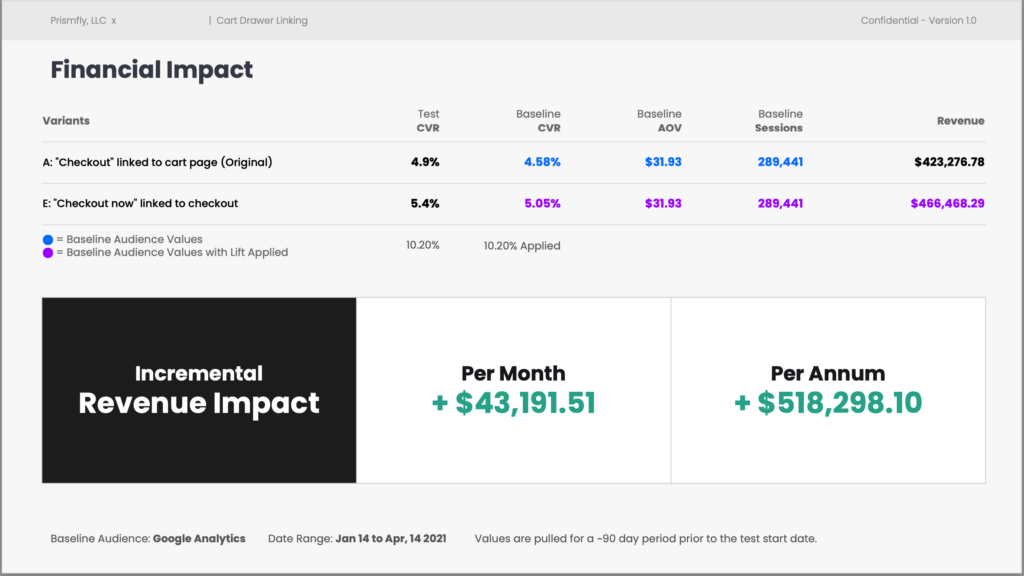
3. Focus on high-impact, low-effort tests
By prioritizing tests that require fewer resources but have the potential to make a significant impact on conversion rates, businesses can achieve meaningful results quickly and efficiently. This approach can lead to quick wins, increased revenue, and improved user experience, all of which can have a positive impact on the overall success of the business.
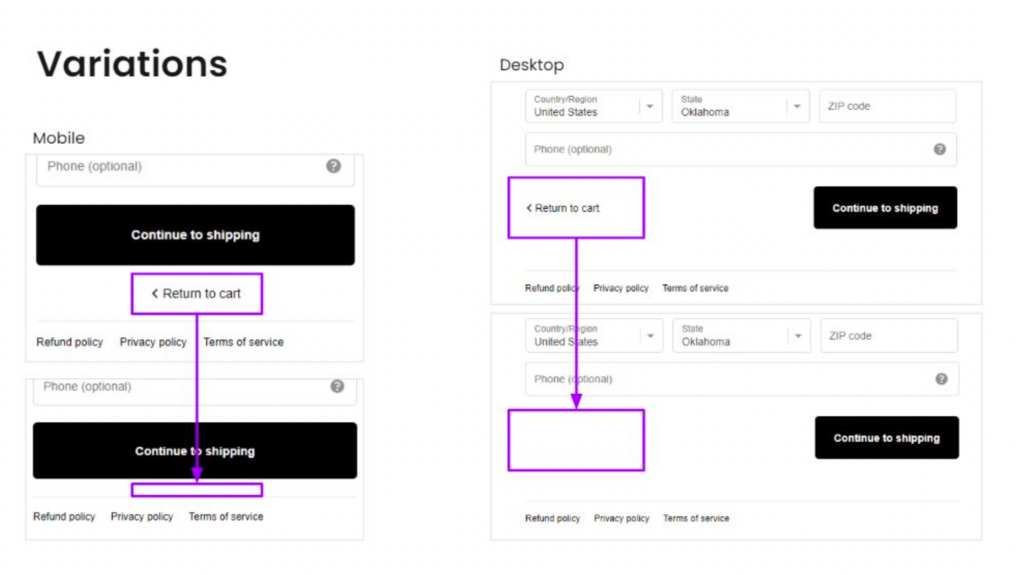
In the example below, this test in the native Shopify checkout takes less than 10 minutes to set up. We’ve seen checkout conversion rates increase as high as 10%.
4. Break down the results on key audiences
Even if a test fails to produce the desired results, breaking down the results by key audiences such as mobile, desktop, and new or returning visitors can provide valuable insights. By analyzing the data, businesses can identify patterns and trends among different segments of their audience, which can help them to understand why the test may not have worked for certain groups. This approach can lead to actionable insights for improving the user experience for specific audience segments, which can ultimately lead to increased engagement and conversion rates.
5. Optimize for higher revenue, not necessarily conversion rate alone
A joke we like to make when business owners come to us is, “The best thing for your conversion rate is just to make your product free. Everyone’s gonna buy it right?” Said nobody ever. The point we are trying to get across here is to optimize for higher revenue, not conversion rate. Conversion rate (CTR) is one metric out of a lot of metrics that matter, in addition to average order value (AOV) and customer lifetime value (LTV).
For example, we often work with subscription companies—like protein powder companies or skincare companies—on their product page. If you default to the ‘Subscribe and Save’ option, what you will often see is a dip in first-time purchase conversion rate. In this case, you will actually lose money, meaning the conversion rate will be lower.
But, if you know your retention rate is good for a specific product (let’s say for at least two to four months) and you are able to get an extra 5% of people to opt into a subscription, your overall LTV will be much higher. So, as a result, you are going to make more money in month two and month three. That is going to completely justify the loss of revenue and dip in conversion rate upfront. This is an example where the conversion rate isn’t necessarily the Northstar.
Grow your brand with the right experimentation
With these five tips, you can minimize risk while performing the right kind of experimentation to take your brand to the next level. Stay focused on revenue, not just conversion rate, and start with high-impact, low-effort tests to start experimenting with what’s working best for you and your customers.
As an ecommerce brand, an optimized tech stack is critical in driving overall revenue performance. Any hiccup, downtime, or misfire can risk immediate revenue opportunities and negatively affect long-term retention and revenue strategy.
To ensure a streamlined tech stack that also streamlines revenue, all touchpoints and sales channels should be considered.
This article covers key strategies and technologies you can implement in your ecommerce business to ensure your customers have a frictionless brand experience. These tactics, technologies, and strategies will help keep your brand operating at peak revenue and tech performance in 2023 and beyond.
Awareness: Deploy a data-driven advertising & content strategy
You only have one chance to make a first impression, and with customer acquisition costs (CAC) continuing to rise, it’s essential to get it right early on to avoid costly, timely, top-of-funnel errors.
As with any paid strategy, there are high-risk/high-reward considerations and it’s recommended to work with an expert who understands big-picture strategy and the day-to-day tactics. Below are important initiatives to streamline and track within your advertising strategy.
- Multi-channel marketing and big-data tracking: It’s crucial for brand awareness to be omnipresent and best positioned for the highest chance of a conversion. Be sure to track engagements and drop-off points at all stages and consider both successes and failures as guide points to increase budget and scale.
- Large network and platform updates: Ensure you have a pulse on any enterprise and major network updates—such as Google’s upcoming cookie and analytic changes—to avoid downtime. With the current version of Google Analytics sunsetting this summer and Google pushing for a cookieless future in 2024, tracking ad campaigns will look much different in the coming years. Get ahead of this now and upgrade your analytics platform.
- Revenue and profitability: Be sure you have air-tight tracking and reporting in place for all revenue metrics, especially return on ad spend (ROAS) and CAC. Turn off ad groups once spending has reached a certain limit and build a unified data source where conversion metrics and top-sellers are reported by margin. This data will inform strategy and profitability, and identify optimization opportunities up and down the funnel. Consider a unified analytics tool like Daasity to track trends across key data points.
Segmenting your audience and targeting specific groups with personalized ads can also help lower your cost per acquisition (CPA) and improve the effectiveness of your advertising spend. By understanding the behavior of these different customer segments, you can create more targeted and personalized marketing campaigns that are more likely to convert.
Personalization, positioning, & subscriptions, oh my!
It’s no secret that ecommerce personalization increases revenue, on-site engagement, and loyalty. In fact, according to a study by Dynamic Yield, 45% of consumers say they are more likely to shop on a site that is personalized versus not. And, if your advertising is personalized and targeted, the on-site experience should be as well.
An integrated experience solution like Nosto is a powerful tool for building a personalized, digital experience. Nosto can personalize your customers’ experience even down to weather conditions that affect shipping.
This is your foundation for building strong brand and customer loyalty, increasing lifetime value (LTV), and balancing CAC. This strategy creates a community that extends beyond one-time purchases and turns customers into evangelists of your brand.
What’s even better is that your brand has ultimate control of margin, conversion, and discount data points and where these apply in the customer journey. Brands like Chubbies and PuraVida are using Nosto to help personalize their customers’ ecommerce experience every day.
Now, what happens when you pair your personalization strategy with your review strategy? You increase conversion likelihood by four times, according to a recent case study from Okendo. For ecommerce reviews and insights, Okendo has over 50 integrations and an insight product that gathers real-time data through surveys.
Through these insights, you can learn customers’ buying habits, preferred products, preferred communication, and repeat purchase trends. Once repeat purchases are trending to three times or more, it’s time to start thinking about subscriptions. You’ve done all the hard work, now how do you keep them coming back? Create subscription and bundled offers that are irresistible.
So, how do you maximize your subscription strategy?
A subscription solution such as Recharge can help you grow average order value (AOV) through upsell workflows that are native to your brand’s user experience (UX). These workflows allow your customers to try new products and even combine one-time purchases with their subscription purchases.
This strategy even talks back to your SMS strategy, communicating upcoming charges or alerting your customer if a card has been declined. You can even set alerts for your brand if a customer cancels their subscription.
A streamlined subscription strategy, paired with an intuitive UX, can also help reduce churn and increase brand loyalty. By giving your customers the flexibility to swap products and skip, reschedule, or pause deliveries in their personalized portal, customers have ultimate control of their subscriptions. This self-service helps prevent costly cancellations.
Tracking, optimizing, & iterating
Now, many different analytics and tracking platforms are available to track and unify all of this data, each with unique features and capabilities. Some of the key features to look for in an analytics platform include the following:
Real-time data: The ability to view data in real-time allows you to make informed decisions quickly and react to changing market conditions.
Customizable dashboards: Look for a platform with flexibility, that allows you to create custom dashboards to show the most relevant and revenue-impacting data to your business.
Multiple integration options: The ability to integrate with other tools in your tech stack, such as your ecommerce platform and CRM, gives you a holistic view of your business performance.
Advanced segmentation: Look for a platform that allows you to segment your data by various criteria, such as location, device type, and referral source, to get a more detailed understanding of your audience and their behaviors.
Attribution modeling: This helps you understand the impact of different marketing channels on your overall business performance. It can be particularly useful for ecommerce businesses with complex sales funnels.
Choosing and customizing the right analytics platform for your ecommerce business can be daunting, but it is an essential step toward maximizing your revenue performance. By selecting a platform with the reporting features that are most relevant to your business, you can gain valuable insights into your audience and marketing efforts and make informed decisions to drive growth.
Tying it all together with frictionless UI/UX & lightning-fast performance
Site performance is another critical factor that can impact your ecommerce revenue performance. To optimize site performance, consider using a combination of technologies such as speed optimization tools, user interface (UI) and UX optimization platforms, and headless commerce solutions.
Check for speed blockers such as old code or large uncompressed images. These technologies and checkups can help improve the speed and functionality of your website, leading to better user experiences and, ultimately, more sales. Headless commerce solutions allow you to decouple the front end of your website from the back end, giving you more flexibility and control over the customer experience.
Working with an ecommerce agency such as Alpha Omega can also help you identify on-site growth opportunities and optimize your overall ecommerce strategy for peak revenue performance.
Cart integration
Shopping cart downtime…ick! Integrating your tech stack with a cart platform such as CartHook or Bold Cashier can help streamline the checkout process and improve your ecommerce conversion rate (CVR).
These platforms offer features such as abandoned cart recovery, one-click checkout, and post-purchase upsells, all of which can help increase conversions and revenues. Additionally, integrating with a cart platform can help you track key metrics such as cart abandonment rates and AOV, allowing you to identify areas for improvement and optimize your checkout process for peak revenue performance.
AOA helps brands create frictionless digital experiences that drive peak revenue.
Contact AOA today for a tech stack audit.
Most businesses will always have a goal to generate new revenue streams. However, adding subscriptions to your existing ecommerce business can open up many doors beyond the obvious new revenue potential.
Most ecommerce businesses know that adding product lines to your site is not enough to generate new sales. Ecommerce models must account for the full sales cycle, and subscriptions are no different.
The subscription model offers businesses a new way to connect with their customers, bolster those relationships, and find innovative ways to satisfy them cycle over cycle. Here are some of the ways your business can gain value from subscriptions—beyond boosting your bottom line.
The benefits of subscriptions
Boosting brand loyalty
Most ecommerce brands know that the best types of customers are repeat customers. Little to no acquisition costs, better product placement, a reduced need for customer service, lower risk of fraud, and a higher chance of brand evangelism are just a few of the reasons why brands love customers who buy over and over again.
However, these types of customers don’t just appear overnight. Your company must have great products, an easily navigable website, strong customer service, and quick and easy ecommerce fulfillment options. If all phases of the ecommerce customer lifecycle are in order, customers will be more likely to buy repeatedly. After a few purchases, these types of customers have demonstrated a certain level of brand loyalty and are strong candidates for the subscription model.
Those who sign up for daily, weekly, or monthly deliveries are clearly fans of your brand. They use your products consistently and have decided to make your company a part of their lives. Transferring your loyal customers to a subscription model synchronizes the relationship between brand and customer, which opens up even greater opportunities to maximize customer lifetime value (LTV).
Predictable revenue from repeat customers
By creating an ecosystem of loyal customers, your business doesn’t just gain brand evangelists and enhanced LTV year-over-year—your finances and accounting also become much clearer. By implementing a subscription model, you will be able to more accurately predict how much revenue those products will drive in each cycle.
As subscriber counts increase or decrease, you can model out future profit margins. This allows for enhanced insight into what products are working, and empowers your C-suite to better allocate funds and resources across the company.
A subscription model can surface greater awareness and confidence to invest in new product innovation, departments, marketing campaigns, and other lead generating opportunities. Many sales organizations fear overspending and overinvesting in areas that may not be fruitful down the line. By leveraging your subscription revenue, you can more effectively understand your numbers and more wisely allocate funds for reinvestment.
Increasing AOV & LTV through upsells & cross-sells
Subscription customers are loyal to your brand and trust your products, creating the perfect landing zone to offer new products and services that increase the value of each order.
Let’s use a makeup brand as an example. Customer A receives an eye cream and lip kit every three months, but they do not subscribe to any other product lines. They have demonstrated their brand loyalty through consistent consumption of eye cream and lip kits. In this case, we would encourage the brand to send test samples in the next box to encourage Customer A to try other product lines.
The merchandising for upsells and cross-sells can also be done digitally to reduce costs. Suggesting products for customers to add to their carts, or sending personalized emails and SMS messages that serve the same purpose, can fortify the bond between brand and consumer while opening new doors for higher average order value (AOV). It is much easier to upsell to an existing customer than to convert a new customer. After all, the existing customer already has their foot in the door with your brand.
Increasing login & account-based brand value
We all know that customer data is more important than ever. Knowing who your customers are, what they like, their buying habits, and their wants and needs helps bridge the knowledge gap between customer and brand.
By mandating the account creation process for subscribers, you are absorbing a great deal of customer insights. Remarketing campaigns, upsells, cross-sells, personalized branding, and promotional offers are just some of the ways you can reach your customers and drive more revenue.
Eliminating recurring billing processes
Once a customer signs up for recurring deliveries, they have entered their fulfillment information once and for all—unless, of course, they need to update it later on due to an address change. Cart abandonment is one of the most predominant issues that ecommerce companies face, so reducing or eliminating this step is paramount for prolonged revenue growth.
Subscription models do not require customer action, which means there is far less likelihood that the order is canceled due to the cumbersome process of filling out credit card and delivery details. By eliminating this point of friction, your brand can focus on product satisfaction, fast fulfillment, and great customer service instead of cart abandonment.
Boosting conversions through trials & promotions
You can offer trials and promotions that entice people to try your products much more easily with subscriptions than other methods. For instance, one free month could get someone hooked for six months of your product or services.
Better product innovation
In tune with the benefit of more accurate profit forecasting, consistent revenue through subscriptions permits higher levels of new product development. Through data insights, you can learn which products are consistently ordered and where you may want to double down or make new investments.
Perhaps the best place to start for your brand is to offer new flavors of your bestseller. Or, you might consider creating a complementary product to your bestseller to complete the regiment. Your most loyal customers know your brand the best—you should leverage their data to make the best decisions for new product creation moving forward.
The power of choice & personalization in subscriptions
Your customers are human, and humans like control. Control of product development, product choice, delivery cadence, and billing sequencing are handed over to the customer to provision.
We’ve been speaking to the power of personalization for years now, and robust subscription models take advantage of this. From offering custom boxes and complementary product add-ons to options to skip a delivery or split payments, there are many choices that brands can give their customers to give them greater control and flexibility.
Customers want to feel like they are a part of the brand and that their opinion matters. By allowing for greater personalization in your subscription offering, you set the stage for reducing churn and maximizing LTV.
Headless is a term that is gaining traction in the ecommerce industry, but one that many find hard to understand. We sat down with Scott Knight, Founder and CEO at Alpha Omega Agency (AOA), on season three of our Hit Subscribe podcast to learn more about what headless means and the impact it will have on the future of ecommerce.
Introducing AOA
AOA is an agency all about innovation—and they’ve focused on headless because it is where ecommerce is headed (no pun intended). Scott described their agency as obsessed with performance. They’re committed to building digital products that will help their clients succeed in big ways, and they’re able to do so with a team of developers leveraging modern technologies and powerful experiences. This gives their design team the flexibility to create incredible user experiences, helping their clients boost revenue in the process.
Defining headless
To get started, let’s define what headless means. As Scott mentioned, headless has become an ecommerce buzzword, but a lot of people don’t actually know what it is.
It’s the separation of the consumer-facing side of the application from the backend.”
Scott Knight, Founder and CEO at AOA
In other words, headless commerce means that the brand’s frontend system is decoupled, or separated, from the backend system. This is different from traditional platforms, where the front and backends are intertwined—meaning it’s hard to edit pieces of the code without interfering with the user experience.
Benefits of headless
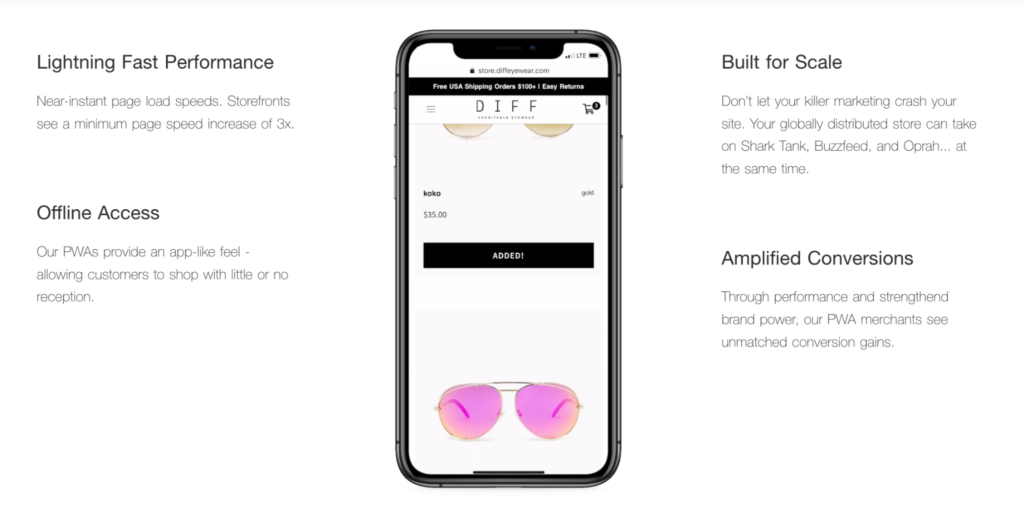
So, why are ecommerce brands switching to a headless architecture? It gives merchants the freedom to create a seamless customer experience, with full control over customization. If you visit AOA’s website, you can learn more about the benefits of headless, such as:
- Lighting fast performance
- Offline access
- Built for scale
- Amplified conversions
Why the shift to headless?
With the rapid growth of ecommerce in the United States over the last few years, merchants are increasingly looking for ways to set themselves apart from their competitors. Shifting to headless can speed up their site—helping them to offset the cost of customer acquisition by increasing conversion rates.
Scott commented on the huge shift to online that happened in 2020, and how ecommerce continues to grow year after year. This growth has accelerated competition, and customer acquisition costs have increased to 50% in the last year.
Brands are hyper-focused on providing a really unique experience to differentiate themselves from that increase in competition, but also on performance…And there’s really nothing better that can help with that than speeding up your site.”
Scott Knight, Founder and CEO at AOA
For merchants that want to stay a cut above, going headless is the natural next step.
The pillars of headless architecture
To better understand the benefits of headless commerce, it’s important to know what makes it unique from traditional platforms. Below we’ll explore the various ways headless can improve your user experience, as Scott identified on the podcast.
1. Speed
Site speed is crucial when running an ecommerce store. When a website takes a long time to load, it can be a discovery deterrent. Many studies have shown that if a page takes longer than three seconds to load, users bounce. On the other hand, fast site speeds have been shown to increase conversion, average order value (AOV), and revenue.
Speed is a benefit, because…lag time and slow performance really is a discovery deterrent. And so, by increasing the speed…what that does is that increases conversion, that increases AOV and then ultimately the bottom line. So, speed is hyper-important.”
Scott Knight, Founder and CEO at AOA
2. Scaling
Another huge advantage for merchants using headless architecture is the ability to scale easily. Using prebuilt systems, information is pulled together easily and efficiently to create one clean backend that’s pulling in data from all over. With this model, merchants can scale because they don’t have to worry about how the system will flow—everything is maintained on its own.
The opportunity to leverage these tools has really driven down the cost of development and has made things scalable, flexible, so that if you want to make a change…you can make that pretty quickly.”
Scott Knight, Founder and CEO at AOA
3. Integration with third-party apps
Over the last few years, third-party apps have matured and now many support this headless commerce. Before, merchants had to work with their agencies and developers to get their systems to support these third-party apps. Now, headless is seen as the future of ecommerce and the ability to bring third-party integrations has been simplified.
4. Access
Another major perk to headless commerce is the ability to browse a site, even when you lose internet connection. With headless architecture, customers can continue shopping on your site and adding things to their cart without the internet. This is all thanks to a progressive web app, which installs the sites locally on your phone or laptop. So, losing connection won’t mean losing customers for those ecommerce merchants that have switched to headless.
A real-life example: BlendJet’s headless site
So, what does a headless site look like in real life? Or rather, how does it make a difference in the customer experience and help a merchant increase their AOV and overall revenue? Scott walked us through a few examples in the podcast. Let’s look at BlendJet and see how it all comes together.
[BlendJet has] a very rich site. So, we’ve talked a lot about content and how it’s a separate experience, but it doesn’t have to be a separate experience. And what I mean by that is blogs and articles, a digital experience…can very well be accompanied with product, with product detail, and providing a little bit more of a robust experience for customers.”
Scott Knight, Founder and CEO at AOA
BlendJet’s website knocks this idea out of the park. Their images and videos create a rich experience encompassing all of their products—beautifully combining content with products to create an optimal customer experience. This type of integration, coupled with fast site speeds despite the number of videos and images, wouldn’t be possible on a traditional platform.

Is headless the future of commerce?
All signs point to yes, after speaking with Scott from AOA. For merchants that want fast site speed and the ability to scale quickly and easily—a headless site architecture could be the right answer.
Check out the full interview with Scott, as well as conversations with other industry experts, on our Hit Subscribe podcast.
Thanks to Nihar Kulkarni and James Roberts of Roswell NYC for providing this post.
Subscriptions defined
Subscriptions are essential to the health of many businesses, but are they right for your business? We’re going to explore WHY subscriptions are so important, as well as their wide variety of applications across a spectrum of industry verticals. But first, let’s get some homework done and understand some key metrics: MRR and LTV.
Monthly recurring revenue (MRR) is like a salary. It’s a predictable amount of monthly income that allows merchant businesses to better forecast future cash flow and plan ahead on how to use that (*somewhat) guaranteed revenue in the short run to plan for long-term growth. It can lessen your dependency on external cash resources (for example, business lines of credit, term loans, outside investors eating up percentages of ownership) to fund your short-term liabilities. As a direct-to-consumer brand, this can mean less reliance on discounts to incentivize sales and generate revenue when needed. This in turn means higher margins and happier B2B relationships with wholesale clients who don’t see you as a competitor.
Next up is the holy grail of ecommerce sales metrics: lifetime value (LTV). LTV roughly translates to all the money a customer or group of customers will spend on your products throughout their lifetime. Morbid to think about, but nonetheless critical to understand. The actual calculation varies based on who you speak to. However, at Roswell we equate it to:
Average order value (AOV) x Frequency of purchase (FOP) x Average customer lifespan (ACL)
There are several reasons why this stat matters the most, the first being that it encapsulates all of the other KPIs you have traditionally monitored. Low conversion rate = lower AOV, lower FOP, lower ACL—and vice versa. Supplementing strategies to increase conversion and AOV, coupled with a strong retention marketing strategy to drive FOP, results in—you guessed it—high LTV.
And how do you increase FOP with minimal ongoing marketing efforts? That’s right, subscription. We get our Bully sticks at home from BullyBunches.com and we don’t even think about how it got here, but our little Morkie Zuri sure is happy, and that’s what matters.
The majority of brands have an FOP closer to one, as the majority of marketing efforts are placed on top of funnel strategies. But coupling paid search, social, and SEO with subscription and retention marketing is a true recipe for growth. LTV is so important because it indicates the potential true value of your brand. This KPI should guide your marketing budget, resource investment, inventory decisions, and forecasting. It tells you whether you can spend more now to attract customers knowing their average value over time will be worth it. It’s also an indicator of whether people like your product and if they are willing to buy it again and again.
In fact, the true value of your business can be determined by multiplying your customer LTV by your total existing customer base. If you can increase your LTV by 20%, that essentially increases the value of your paying customer base—and therefore the value of your business—by 20%.
We all know how hard it is to acquire new customers online, and how new customers convert only half as much as returning customers. Paid Digital Marketing has faced tremendous upheaval over the past two years with the pandemic, increased competition, and changing privacy rules. We’re all working hard to acquire those new customers!
So, why not focus as much energy as possible on increasing the value of each and every one of them? This is just another way subscriptions can play an enormous role in increasing the overall health and value of your business. One of our clients, a new CPG food brand, is already generating 26% of their revenue from subscriptions.
If you’re considering starting a subscription program for the first time but aren’t convinced about user adoption, consider that currently, roughly 51 million consumers in the US are using D2C subscriptions.
Subscriptions for all
Now that you understand those key metrics, is a subscription model right for your business? Don’t think about subscription as it applies to something you use, run out of, then need again. Of course, that is one use case, but what about memberships that provide exclusive product access, free shipping, customer perks, and gated content? Where there is value, there is an opportunity to use subscriptions to provide access.
With the industry move to Shopify’s unified checkout, the user experience is even more seamless, as users are not taken to a third-party checkout, which can be a jarring experience that increases conversion friction (not to mention wreaking havoc on your analytics). With tokenization standardized in Shopify Checkout, customers can now have their payment options stored securely, and using Recharge’s highly evolved subscription infrastructure platform, users naturally check out with subscription and one-time products without even realizing the years of research and development that was put into giving them what they want—when they want it.
Get me on Recharge!
Roswell NYC has migrated countless merchants to Recharge. Our approach is a three-pronged strategy:
- Integration of Recharge with your Shopify backend inclusive of full product database set up, settings adjustments, and customer subscription admin tools
- Migration of legacy subscriptions on day one to Recharge and subsequent token mapping in Shopify to ensure no disruption in recurring orders coupled with migration of the delta of new subscriptions on launch day
- Front end customer experience development on PLP, PDP, Subscription Upgrade in Cart, Subscription Administration in Customer Account Dashboard
But don’t just take our word for it, check out these examples:
Reduce churn
What makes a successful subscription customer experience (CX)? When analyzing a cohort (looking at groups of people that subscribed at a certain time, and observing how their behavior changes over time) it is essential to understand your churn rate. It’s even more important to understand how to reduce it. Let’s take a look at your options:
- Recharge’s Novum theme provides the optimal out-of-the-box subscription administration experience. Let customers decide their subscription journey, rather than dictating it to them.
- Provide simple, functional, and easy-to-understand UX on all touchpoints of the subscription experience. PDPs and Subscription Landing Pages should easily guide customers to understand the benefits of subscribing. In-cart subscription upgrades are akin to cross-sell. Their product is in the cart as a one-time purchase—remind them that they can upgrade to a subscription!
- Automatically re-target customers who have canceled with incentives to re-engage their subscription via out-of-the-box integrations with Klaviyo and Attentive.
Let’s sum it up
Anyone who is actively engaged in paid digital marketing to grow their business knows all too well that acquisition costs have increased as digital marketing competition increases and privacy rules impact targeting methods. Find your subscription opportunity and present it through storytelling elements on PDPs and Subscription Landing Pages. Integrate or migrate to Recharge (feel free to call us!), and focus on reducing churn. Then watch your LTV grow.
We’re thrilled to announce the launch of the new Recharge Agency Partner Program. Our mission is to give agency partners the resources and tools to grow a robust subscription practice while helping merchants benefit from the thriving subscription economy. This program paves a clear path to unlocking new benefits and revenue opportunities as agency partners invest in a relationship with Recharge. It also helps merchants identify partners who have expertise in setting up and optimizing subscription programs.
What does the new program look like?
Recharge currently offers three levels of partnership within the program: Registered, Select, and Premier. Registered is our entry level and gives new partners immediate access to the tools, assets, and revenue opportunities to start growing their subscription practice with Recharge. As partners start to build expertise and move to the Select level, they’ll have the opportunity to gain additional technical, sales, and marketing support and be eligible to receive merchant referrals. Our most engaged partners have earned Premier status and will receive the highest level of support, co-marketing opportunities, and exclusive access to programs to support their continued growth.
What makes Recharge agency partners stand out?
Recharge agency partners help bring subscriptions to life.
We’re lucky to work with some of the best agency partners out there and are consistently blown away by their dedication to helping merchants solve their most pressing business challenges. The ecommerce industry has undergone unprecedented change over the past few years, and subscriptions have proven to be an exceptional way for merchants to connect with and create long-term relationships with their customers. Recharge agency partners have helped thousands of merchants set up and optimize their subscription programs, driving increases in average order value (AOV), customer lifetime value (LTV), and monthly recurring revenue (MRR).
Want to learn more?
For agencies that are interested in learning more about the Recharge Agency Partner Program or applying to become a partner in the program, please visit our program page. A detailed description of the benefits and requirements of the program can be found in our Program Guide.
For merchants that are looking to partner with one of our amazing development and design or marketing agencies, you can search and connect with prospective partners via our agency partner directory.
In the past three years, we have seen a massive boom in the ecommerce subscription space. By 2023, ecommerce-driven subscriptions are expected to generate more than 38 billion dollars in revenue. To put this into perspective, that is more than double the amount of revenue driven in 2019.
The increased traction for subscription-based models will only continue to grow. 54% of online shoppers are active subscribers who, on average, hold at least five retail subscriptions.
What does this mean? In the simplest of terms, the push for DTC merchants to implement subscriptions into their framework is paramount. That being said, just offering your customers subscription options isn’t enough—merchants need to have a thoughtful strategy in place.
In this blog, we will discuss how you can determine what kind of subscription plans fit your customers’ needs, and how yearly subscriptions can be a powerful revenue generator for many businesses.
The types of subscriptions
Before we get into the weeds here, it’s important to understand the different types of subscription models so you can choose what works best for your business.
Curation, replenishment & access subscriptions
Recharge does a great job at breaking down the different subscription types, but to briefly touch on the topic, there are three main categories of subscriptions:
- Curation subscriptions (e.g. Blue Apron): Here, subscribers receive an assortment of products, generally tailored to fit a certain theme.
- Replenishment subscriptions (e.g. Smartypits): Here, subscribers receive recurring deliveries of specific products or services that they use on a regular basis.
- Access subscriptions (e.g. Savage X Fenty): Here, subscribers pay for access to exclusive perks, products, or gated content.
Each subscription type can be offered on either a monthly or annual pricing model. Each revenue driver has its own pros and cons for both your brand and the customer.
Monthly subscriptions
The monthly subscription model is a great way to increase customer loyalty and keep your customers coming back for more. It provides an easy way for your customers to try new products, and allows your business to track customer spending patterns over time.
Because orders repeat on a monthly cadence, this model also offers regular, built-in touchpoints to connect with your customers about their orders, which can lead to increased customer engagement.
Of course, monthly payments aren’t a fit for every product type or customer base. Depending on the unique needs of your business and subscribers, it may be worth considering offering an annual contract to increase customer lifetime value and reduce churn.
Annual subscriptions
Annual billing can also provide a number of advantages for your customers and your business, including increased customer loyalty, increased sales, and easier and more accurate inventory management. Yearly subscriptions are also high revenue generators: By offering your customers the option of paying annually instead of monthly, your business will receive a larger sum of money upfront. This allows you to have a more predictable stream of recurring revenue, which is incredibly important for any business looking to expand.
However, people who are trying out your company’s products or services for the first time may also be reluctant to commit to an annual subscription, causing potentially high barriers to entry.
For most of our readers on this post, your business may already have a subscription model in place. You may be thinking, how do we convert our monthly subscribers to an annual plan?
Moving customers from monthly subscriptions to annual
Moving your customers to annual subscriptions can help improve both retention and cash flow for your business. To do this successfully, here are a few of many questions you should be asking yourself as you map out your strategy:
- Do I have the right digital framework?
This simply means making sure your digital framework offers a seamless experience for users when trying to upgrade to annual plans. Taking it a step further, it also requires you to dig into your site and apps capabilities. Are they enhanced and capable of handling plan upgrades?
- When will I initiate the upsell?
Understanding your customers’ purchasing behavior is key to knowing when to initiate an upsell. One of the biggest drivers to move to an annual subscription plan is based on a large discount on the annual fee. When mapping out when you plan to push an upsell, keep in mind that upsells typically take place right at purchase or later on via email.
- Is there a subscription marketing plan in place?
Have a marketing strategy mapped out based on tactics that speak to your customer base, whether you are using influencer marketing, email campaigns, social media, special offers, or a combination of them all. During this time, craft your messaging to speak to what differentiates your products from your competitors.
Final thoughts
When done effectively, increasing your annual subscription count by converting monthly subscribers to annual can not only increase your upfront cash flow, but also improve long-term customer retention. This means more time to nurture customers to get them to renew.
As you continue to map out your strategy, remember that although there are many benefits to pushing annual subscription plans, you should be prepared to address some key considerations. These include high barriers to entry and less built-in opportunities to engage with your customers.
Regardless of the model you end up choosing, subscriptions in the ecommerce space are a journey of learning what works best for your business model and your customers. To keep your customers with your business, there should always be learning and adjusting taking place. Good luck on your subscription journey!
This is a guest post from our friends at P3 Media, an ecommerce-focused digital agency.
Let’s not sugarcoat it: The cost of acquiring new customers in ecommerce is going up. Customer acquisition costs (CAC) rose 60% between 2015 and 2019, and between 2020 and 2021, the cost of advertising on Facebook jumped 59%. Meanwhile, Apple and Google are phasing out the third-party cookies that marketers rely on for accurate ad targeting.
In other words, advertising costs are higher than ever, but ad efficacy is lower than ever. Most online brands need to shift a portion of their focus from attracting new customers to retaining the customers they already have. That requires investing in loyalty programs, customer service, and especially, subscriptions.
Why subscriptions?
Subscription services are your most predictable source of returning customers, and returning customers are your most valuable customers. In ecommerce, between 20–50% of your transactions come from returning customers, and for most merchants, those transactions account for the lion’s share of the revenue. In fact, the Pareto Principle observes that the most loyal 20% of a brand’s customers will generate around 80% of its revenue.
And that’s not all. Returning customers cost nothing to acquire and take shorter journeys to conversion, meaning the margin on their purchases is higher. These are just a few of the many reasons that retaining your subscriber base—or implementing a subscription business model in the first place—is fundamental to your business health.
But, if you’ve ever clicked ‘Subscribe’ online, you know that subscription fatigue is real. Unused products pile up. You keep getting billed. Sometimes, you’ve signed up for so many subscriptions you can’t keep track of them. And suddenly, those monthly deliveries start to feel like a nuisance, rather than a convenience. If you’re thinking, “There must be a better way,” you’re right. Here are three powerful methods you can use to combat subscription fatigue and grow a healthier, happier, and more engaged subscriber base.
1. Create tiered subscription rewards to court your best customers
‘Subscribe-and-save’ is the most powerful enticement you can add to your checkout experience. But you can amplify the power of this promise. Remember the Pareto Principle from earlier? It applies to your subscribers, too. The top 20% of your subscribers will account for around 80% of your subscriber revenue. And those customers deserve to be celebrated with extra freebies, points, and exclusive promotions.
If you have a flat subscription model with few options, you can identify your best customers by building a subscriber lifetime chart and segmenting customers that fall into the top 20%. If you offer tiered subscriptions, you can use subscriber lifetime value (LTV).
Creating a structure to reward your most actively engaged customers for their tremendous loyalty will further deepen their engagement, and give those just on the other side of the VIP rope a powerful enticement to keep spending with you.
The key to this strategy is to offer rewards that have real value in your customers’ eyes. Don’t try to offload surplus products or a gift with purchase (GWP) with no inherent value. That kind of first-order customer satisfaction problem-solving might look good on your balance sheet, but it erodes shopper satisfaction.
Instead, give your best customers something from the top shelf. Or, give them something unique, like an experience or an exclusive deal with one of your partners. You can even gift free subscription months, first dibs on new drops, or special access to a product testing beta. Take Bumpin Blends, for example. Their customers can earn amazing rewards like first access to new flavors and points that can be used on smoothie cubes, or even a free Vitamix blender.
The possibilities are endless, but whatever you choose should be tailored to feel relevant, timely, valuable, and unique to your specific customer.
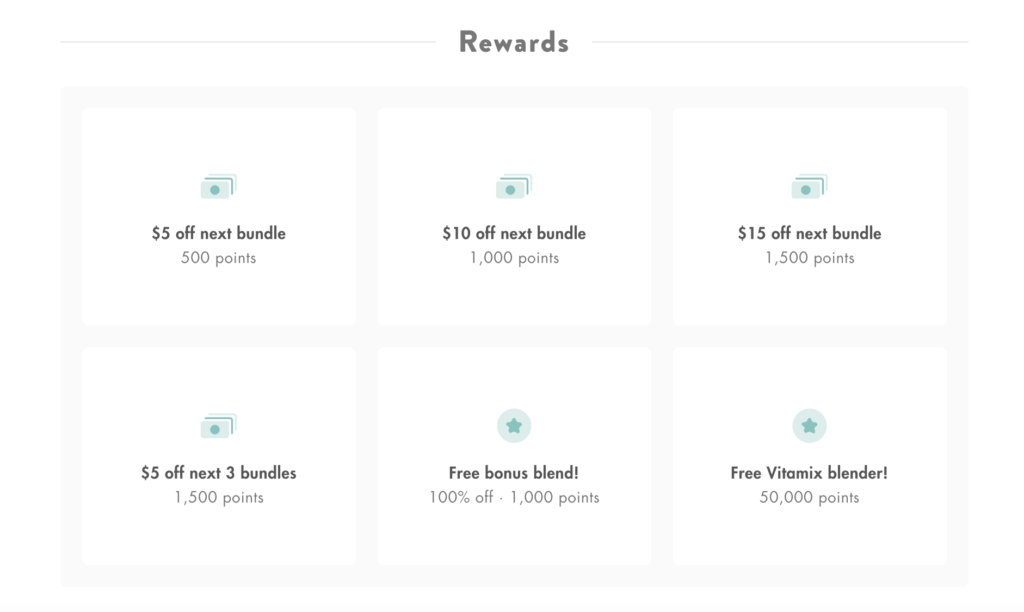
A snapshot of what shoppers can buy when they earn points with Bumpin Rewards.
2. Incentivize subscribers to stay when they’re most likely to leave
How many months on average do customers stay in your subscription program before churning? What’s the main reason they’re leaving? If you know these two vital pieces of information, you can reduce your churn substantially.
What’s the best way to do this? Offer meaningful loyalty rewards pegged to your average subscriber lifetime. If subscribers churn after nine months on average, then send them an amazing, exclusive reward around month eight for their loyalty.
One merchant that is excelling at offering incentives is LOLA, makers of period and sexual wellness products. By creating a membership program and giving their subscribers exclusive access to new products, free shipping, and regular discounts, their customer retention rate remains high. Additionally, offering flexibility and easy changes to orders means customers stick around much longer.

LOLA offers incentives to keep their customers excited and ensure they stay loyal to their brand.
If you know the top reasons your subscribers churn, you can tailor your rewards accordingly. We’ll cover how to collect this information later, but for now, let’s walk through an example.
Say your average subscriber lifetime is nine months, and your customers are churning because they have too many unused products (one of the most commonly cited reasons). In this case, sending them more of the same items for free isn’t the right value add to boost retention. Instead, try sending a free cross-sell item, an inspirational resource like a styling guide or a tip sheet, or even a satisfaction survey that lets you gauge the likelihood of churn and provide personal assistance where needed.
To that end, it’s also wise to educate your subscribers proactively on the flexibility of their subscriptions. In cases like the example above, P3 typically recommends sending an automated email around month six that shows subscribers how to skip deliveries when they need to or modify their subscription options. You can also send reminders to skip deliveries around peak vacation times, or according to your cyclical sales cycle. Customers appreciate these thoughtful touchpoints, and your guidance helps them become habituated to using your service to suit their needs.
3. Offer subscription periods that match your customers’ needs
You’ve likely heard that you need to make your subscription offerings flexible enough to fit the majority of customer use cases. Most businesses rightly take this as a cue to diversify the selection of curated products and bundles to which users can subscribe. But an often overlooked aspect of subscription flexibility is periodicity.
While the subscription model can be a revenue game changer, monthly subscriptions aren’t for every customer or every product. Services like Recharge address this reality with flexible out-of-the-box options like the ability to skip a month or take delivery every few months.
These are powerful features and may provide enough convenience on their own to satisfy the majority of your subscribers. But if you’re in an industry that has a seasonal or cyclical purchase pattern, you’re likely to experience higher-than-average churn rates simply because your products aren’t always in demand.
If you sell wine, cheese, or another festive product, you can account for this by creating an occasional subscription package—for example, one that sends a curated crate of seasonal goodies around major holidays. If you sell a year-round product, you can create a gifting subscription that sends personalized care packages to subscribers’ loved ones on birthdays, anniversaries, or other special occasions. This kind of service is already popular in the B2B world, and there’s no reason you shouldn’t be earning second, third, and fourth purchases from your customers with a similar model.

Bokksu does a great job of offering both regular subscriptions and special gift offers. Loyal customers can order boxes for loved ones to try the service, then continue their subscription if they’d like.
The only caveat is that most subscription providers don’t offer these options standard. In many cases, you can work around this by rolling an occasional subscription into an annual plan. Customers pay upfront and take delivery on the designated dates. If you’re interested in building a bespoke subscription program with more custom features, however, we recommend asking your provider what they can do for you, or working with a reputable agency partner that can develop your custom program from scratch.
Bonus: Make it easy to leave, but ask subscribers why they’re leaving
If you’re just focused on subscription numbers, this sounds counterintuitive. Why make it easy for your hard-won customers to simply walk away? There are two good reasons.
First, if you’re running a well-organized subscription program, you’ll eventually try to re-engage your churned subscribers with a targeted win-back campaign. Second, customers who have a bad customer experience as they exit will never come back, while 93% of customers who have a good customer service experience will shop with a brand again.
Have you ever tried to leave your internet service provider, and found that it’s almost impossible? If ISPs weren’t legally protected cartels allowed to monopolize certain regions, you’d walk away for good, right?
Now about that win-back campaign down the road. It’ll have the best chance of success if you understand why your customers are leaving in the first place, and use that information to fuel your re-engagement efforts. The easiest way to collect this information at a statistically significant response rate is to add a one-question exit survey to your unsubscribe process. We’ve listed some of the most common reasons people tend to hit ‘unsubscribe’ below:
- Subscription doesn’t provide enough value
- Too difficult to modify subscription options
- The customer has too many unused products
- Subscription is too expensive
- The customer has too many subscriptions
- Competitor offers better service
- Bad customer experience
Let’s illustrate the incredible value of collecting this first-party data with a real-world example. Biohm, a subscription service that helps people with their gut health, asks shoppers for their cancellation reasons. People are able to select their reason for cancellation, and then Biohm offers a solution-based response—discounts if the customer finds the products too expensive, different delivery dates if they have too much product, or an alternative product option if the one they used didn’t work. Offering these solutions can help them gather data on why people are leaving, and offer a last-ditch effort to stop customers from churning.
Cutting down on subscription fatigue
All of these customer retention efforts can greatly combat any subscription fatigue your shoppers might be experiencing. Timing is critical when setting subscription periods, offering replenishments, and giving customers incentives when there’s a high risk of churn. Plus, exit interviews can help you get a better idea as a business of what changes you can make to increase customer retention.
The subscription market saw continued growth in 2021. And while the pandemic accelerated the pivot to ecommerce from brick-and-mortar, customer behavior shows that this model is here to stay. As more brands explore the benefits of subscriptions (like recurring revenue, increased loyalty, etc.), they’re looking for the best platform and partners to deliver their customers a great experience.
Here at Recharge, we work with the top agencies in the business to support merchants in creating growth strategies and implementing top-tier solutions. They’ve shared how they’re helping merchants deploy subscriptions, details on unique features they built, and their best advice for merchants as we head into 2022.
Before we dive into their answers, let’s meet our partners:
Meet the experts
As a leading Shopify Plus Partners for design, development, and growth services, Swanky Agency has spent a decade delivering innovative digital solutions that elevate their clients to the forefront of their industries.
Jamersan has helped countless merchants drive revenue-focused campaigns while making sure the technology stays out of the way.
The Taproom creates high-powered Shopify ecommerce solutions for fast-growing businesses.
Hawke Media customizes data-driven, performance solutions to help launch, scale, and invigorate businesses of all sizes, industries, and revenue models.
iamota is a leading Shopify Plus design and development agency partner that helps enterprise merchants succeed on Shopify Plus.
Arctic Leaf takes the time to thoughtfully understand brand voice and vision to deliver unmatched UX-focused website design and development.
Absolute Web is a full-service agency with strong abilities in ecommerce development and management as well as marketing, design + creative, and content production.
The expert opinions
What is the one thing all merchants should think about when deploying a subscription offering?
“Flexibility. It’s important to give customers the option to alter when they get their product delivered based on their unique needs, or to add/remove items per delivery. Convenience is essential to a successful subscription offering.
Although it might seem counterintuitive to let customers skip, pause or delay a delivery, remember that consumable products don’t get used at a blanket rate, so it makes sense to allow customers the flexibility. This can help secure subscriber loyalty and advocacy, which is important for customer retention.”
Matt Abbott, Head of Growth, Swanky Agency
“The biggest single thing to consider is your customer needs. Make sure you are mapping those needs to a subscription offering. Without market fit, subscription offerings are doomed from the beginning.”
TJ Gamble, CEO, Jamersan
“Scalability is vital when a merchant considers a subscription offering. When you only have a few subscribers to start with, it’s smooth sailing and the logistics are easy to manage. However, you need to also plan how you’re going to handle that subscription offering as it grows and gains more subscribers. There are so many aspects to that question. How will it be managed within your fulfillment team? How will inventory be handled? What will you do to ensure it continues to be valuable for subscribers? What impact will scaling this offering have on the rest of your business operations? It’s not enough to have just that base starting plan, you need to think a year, 2 years, 5 years ahead. It isn’t just operational scalability, but what is the merchant going to do to actually scale it in terms of getting more subscribers.”
Shannon Sherry, Director of Marketing, The Taproom
“Subscriptions come in all shapes and sizes – what works for one merchant may not work for another. We work closely with our clients to map out the end-to-end customer journey for subscriptions. This allows us to ensure our merchants’ desired subscription model makes sense from a customer perspective and allows us to create a strategy to tackle any potential barriers to subscription.
Some key considerations:
- Is the subscription offering enticing enough? What are the benefits of subscribing? eg. A discounted rate?
- Is the subscription offering easy to understand?
- Are the subscription options broad enough (pricing tiers, frequency, product options, etc.)?
- How might you reduce subscription cancellation? Can we utilize the Recharge platform to help businesses implement a strong retention strategy, including incentives such as monetary discounts or free gifts or encouraging customers to change their order date or swap out products?
Oli Best, Growth Manager, iamota
“Merchants need to determine their business model prior to deploying a subscription offering because the model will predicate the scope of the work. If you want to sell coffee on a weekly frequency then Recharge will support everything you need right out of the box. If the merchant needs customer billing frequencies, or has a nuanced and unique buyer journey, then they will likely want to find an experienced agency who knows how to leverage Recharge’s APIs.”
Josh Garellek, CEO & Co-Founder, Arctic Leaf
“Merchants need to fully understand what their customers are looking for from an experience standpoint. This will ensure that the subscription offering aligns with the expectations of their customers as well as increases brand loyalty and lifetime value. Beyond that, it is important for the merchant to have a strategy for their subscription offering. We often recommend implementing a “subscribe and save” discount to incentivize customers and then have the merchant advertise it in their marketing communications. One more thing merchants should think about is adding a simple way for their customers to opt-out or cancel their subscription. If a customer knows that they are not locked into anything, they are more likely to give it a try.”
Shayna Silvers, Director of Marketing Strategy, Absolute Web
What creative subscription features have you worked on?
“We’ve been working with a pet supplements brand to help increase their subscription conversion rate and deploying a quiz to provide users with a tailored plan based on the age and weight of their dog. We’ve run many optimizations to this journey, currently focusing on the annual cost savings of being on a subscription over 12 months. 33% of users who start this quiz progress to purchase, which is significantly higher than the site average.
To increase the acquisition of new first-time users, we introduced a ‘sampling to subscription’ offer. A new user is taken through questions to identify the relevant product. They purchase a discounted Recharge product for their first month, before being switched to a full-price subscription.
Utilizing Recharge in combination with Dynamic Yield, we’ve implemented campaigns showing returning users who purchase first-time products repeatedly the benefits of being on a subscription, and personalizing the on-site experience for active subscribers.”
Samantha Fraser, Lead Strategy Manager, Swanky Agency
“We’ve recently launched Copper Cow Coffee’s new site and subscription offering which is by far one of my personal favorite subscription projects we’ve worked on. Given there are so many coffee subscriptions on the market, it really isn’t enough to just have a straight subscription service, so they wanted to find a way to stand out by adding further value to the customer experience.
Everyone drinks their coffee differently and prefers different flavors. But a lot of coffee subscriptions just send the coffee with little in the way of consideration for individual tastes. That meant the key to the customer experience for Copper Cow would be personalization. To achieve this, we worked with them to create an intuitive quiz flow that tailors the subscription to the individual customer. We also built a custom app that would essentially “speak” to Recharge, allowing the customer to further customize the box – removing items, adding new ones on, and the ability to change this month-to-month. This means the customer can try some seasonal brews, or add more of their favorite flavors whenever they want.
What we’re left with is a super intuitive, easy-to-use, totally personalized subscription service. We’re still in the early days having launched only a few weeks ago, but we’re excited to see some results in the future.”
Shannon Sherry, Director of Marketing, The Taproom
“Working with Unilever’s teams in Seattle, New York, London, and India, in addition to Recharge, iamota significantly enhanced the user experience for Skinsei customers via our Road Map approach. We improved the UX and site performance for both potential new customers and existing subscribers.”
Oli Best, Growth Manager, iamota
What do you believe is the most undervalued aspect of the Recharge platform?
“For me, it’s the built-in functionality that allows merchants to apply incentives based on customers’ cancellation reasons. For instance, if a customer wants to stop their subscription because it’s too expensive, you can present them with an opportunity for a discount right there and then. This can be a powerful retention strategy that reduces churn. Spending a few minutes on this can lead to a transformation in your customer lifetime value!”
Nichola Birch, Product Manager, Swanky Agency
“The most valuable features are often the most undervalued. The simplicity of getting started combined with the knowledge and experience from the Recharge team make it our go-to platform for all of our merchants.”
TJ Gamble, CEO, Jamersan
“On the platform side, the most undervalued aspects of Recharge are the integrations it has to ensure it fits into your ecommerce tech stack seamlessly. Beyond that, the incredible customer support that Recharge provides is another huge bonus. Through their work with some of the top ecommerce brands out there, Recharge brings next-level knowledge and expertise to the table for our account managers, prospects, and clients alike.”
Ashley Scorpio, Vice President of Partnerships, Hawke Media
“One of the secret weapons working with Recharge is understanding how it has been built to integrate and work alongside other core apps and platforms within the Shopify ecosystem. From loyalty and rewards to upsells and email marketing, and customer service support. We are able to build a merchant solution that not only brings the value of subscriptions, but combines that with other revenue-driving implementations that bring surprise and delight to the end customer.”
Oli Best, Growth Manager, iamota
“Recharge has a very powerful set of APIs that we don’t think enough merchants are leveraging to take their subscriptions to the next level.”
Josh Garellek, CEO & Co-Founder, Arctic Leaf
How can merchants be successful with Shopify or BigCommerce?
“There are so many strong integrations within the Shopify ecosystem that, when leveraged, allow merchants to succeed with subscriptions – these are what make the platform stand out for me.
Some to point out include Recharge’s Shopify integration with Gorgias, which allows customer service teams to save time as they don’t have to constantly switch tools. There are also its integrations with ESPs which allow you to set campaigns based on subscription triggers (e.g. a customer canceling triggering a win-back campaign), as well as its links with loyalty tools which enable the creation of VIP tiers for subscribers. Plus, there are integrations with analytics tools like Little Data, which help merchants clean their Recharge and Shopify data within Google Analytics so they can truly understand lifetime value and churn.”
Nichola Birch, Product Manager, Swanky Agency
“The primary benefit of SaaS platforms like BigCommerce is that they are simple for merchants to manage. That has two profound impacts that compound to fuel growth. It frees up mindshare so merchants have time to properly strategize, and it alleviates technical boundaries. This builds an atmosphere of exploration and rapid trial-and-error testing that makes it much easier to find your way to success.”
TJ Gamble, CEO, Jamersan
“I think that in order to understand why Shopify is great for merchants looking to get into subscriptions, we actually need to zoom out and take a look at the entire Shopify merchant experience. As a platform, it is so merchant-led and is constantly looking for new ways to allow merchants to grow their businesses.
A huge part of that is the Shopify ecosystem – once you start with Recharge, there are 1000’s of other apps and integrations you can add in to add value to that subscription offering, improve your customer experience, and drive efficiency within your team. You can add loyalty programs to improve retention, inventory management systems to partially automate the fulfillment process, email marketing to boost subscriber communication, and so much more. And if you’re looking for niche functionality, there are so many great Shopify agencies and independent Shopify Experts who can help make that a reality. However you imagine your subscription offering, Shopify allows you to build that and sets you up for success.”
Shannon Sherry, Director of Marketing, The Taproom
“It was great to see Shopify prioritize subscriptions this year, by building the subscriptions model into the foundation of their platform. Customers and merchants alike can now gain the benefits of Shopify’s slick and seamless checkout experience when purchasing both one-time and subscription products. This was a revolutionary change for the platform, and has made it easier for Recharge and iamota to provide more flexibility and consistency as part of the merchant offering.
In addition, Shopify’s product roadmap includes additional features to make subscription models easier to take advantage of by merchants. We’re excited to see what comes next.”
Oli Best, Growth Manager, iamota
“Arctic Leaf loves building subscription businesses on BigCommerce because their strong APIs allow for our team to build unique and completely custom business models. We support merchants who have very unique and complex buyer journeys that Recharge doesn’t cover right out of the box. Our team has the freedom to build middleware and headless integrations with Recharge to support this unique business model.”
Josh Garellek, CEO & Co-Founder, Arctic Leaf
Where do you see ecommerce going in 2022?
“Given that brands need to make consumers’ lives easier than before to avoid them shopping elsewhere, I think we’ll start to see bigger brands and multi-product retailers introducing subscriptions as part of their offering in 2022. After all, it’s easier to make a customer choose what to put in their basket if they’ve already paid for it.
The advice I’d give to merchants as we enter a new year is to always think about things from the customer’s perspective. Base your offering around what customers want, not what you think they should have. Much of this can be informed by data you already have and supported through qualitative research.”
Matt Abbott, Head of Growth, Swanky Agency
“We are still in the infancy of ecommerce. Each year, it gets more mature and difficult to gain marketshare by “following” the herd. The most important thing for the foreseeable future is to build an infrastructure that allows you to remain agile. Keep a close eye on the market and where people are seeing success. Then, as you identify emerging trends and traffic sources, leverage that agility to stay ahead of the curve.”
TJ Gamble, CEO, Jamersan
“Throughout 2020 and 2021, consumer expectations have changed. Many of these changes are trends the industry predicted, but the pandemic really accelerated these. The biggest trend I think we’re all seeing is just how important omnichannel is to the customer experience. In 2020, it was essential for businesses to develop these fluid offline-to-online experiences, and then in 2021 it was online-to-offline. In 2022, this fluidity is going to be the expected norm, rather than a temporary accommodation. I’ve even experienced it myself, being frustrated at not being able to check stock availability in-store when I know I live nearby a physical retail store.
Merchants in early Q1 should look at their current structure for how their customers can go between channels, and identify any points where it may be difficult to get a customer to checkout. I think that it’ll be really interesting to see how subscriptions adapt for omnichannel, perhaps we’ll start seeing subscriptions have fluid fulfillment options e.g. the option to go collect your subscription from a physical store if you happen to be nearby. Or how we can better convert subscriptions through social commerce.”
Shannon Sherry, Director of Marketing, The Taproom
“Despite the move back toward in-person shopping and experiences, there is still a continued boom in online shopping across all demographics. Thus, ecommerce is only going to continue to get even bigger in 2022. We foresee in-person initiatives like branded pop ups or partnerships with big box stores being a bigger focus for brands that have likely been functioning solely on ecommerce the last two years. Additionally, with changing the regulations in the digital marketing space – iOS updates, privacy practices, data regulation, and more – we’re seeing more and more brands looking for support to navigate the landscape which means a greater appetite for partnerships with agencies and technology providers.”
Ashley Scorpio, Vice President of Partnerships, Hawke Media
“There is a clear trend towards convenience within ecommerce and subscriptions play a key role in adding convenience to your everyday life. The more convenient you make subscriptions for your customers, the more loyal they’ll be. This could be achieved by allowing them greater flexibility over their subscription. However, we also want to make sure each decision they have to make is adding value for both the merchant and the customer.
We also foresee businesses becoming more creative in how they retain customers, with the use of exclusive products, surprise products, or additional discounts to thank them for their continued support. We are also seeing businesses create innovative business models based on subscriptions that drive dependable monthly recurring revenue.
Our advice to merchants is ensuring they find the balance between giving their customers the ability to tailor a subscription as much as possible, without complicating the experience. Striking this balance, can be tricky and this is where iamota supports merchants by mapping out the customer journey and user flows, and running user testing to ensure we are building in the right experience with the right level of complexity.”
Oli Best, Growth Manager, iamota
“Merchants need to double down on the retargeting of existing customers. Not every customer is going to be a subscriber from the first time they purchase. A robust email marketing plan with automations that drive one-time purchasers back toward being subscribers is a must! Remember, a subscription model is an ongoing relationship with your customers and it takes time to sell both your product and story to that customer. A customer who purchased a one-off product is the perfect candidate for your subscription model, so just keep that in mind and retarget those customers.”
Josh Garellek, CEO & Co-Founder, Arctic Leaf
How is your agency helping merchants accelerate their business with subscriptions?
“We’re helping merchants to build a more reliable revenue stream. When customers subscribe, it enables the business to separate their marketing activity. Re-marketing becomes less of an expense because they’ve already secured the recurring revenue from those customers, meaning they have more budget and time to focus on new customer acquisition.”
Matt Abbott, Head of Growth, Swanky Agency
“We typically work with growing merchants that are dealing with the pains of outgrowing their infrastructure. We are constantly looking for opportunities to help them continue that growth and subscriptions are often a big part of that strategy.”
TJ Gamble, CEO, Jamersan
“Hawke Media is helping merchants accelerate their business by adding a subscription offering if they don’t already have one and encouraging them to diversify their subscription offering – either by offering a variety of products on a subscription basis, varying the cadence of recurring subscription box shipments, and allowing subscription box customization, or the ability to pause or skip shipments. By partnering with Recharge, we ensure any merchants we work with have access to the best in class solution to power their subscriptions!”
Ashley Scorpio, Vice President of Partnerships, Hawke Media
“With iamota’s wealth of experience in the subscriptions space, we quickly and efficiently help businesses unpack their requirements and create a smart subscription strategy that utilizes the power of the Recharge platform. By adding subscriptions, we are able to help our clients gain the benefits of a more predictable and steady income, as well as increase the lifetime value of their customers.
At iamota we are not afraid to take on more complex projects. We partner with businesses to unpack challenges and find solutions to complicated and unique subscription models, be it highly custom kits, tiered memberships, or on-demand subscription refills.
The Recharge Theme Engine allows us the flexibility to build out fully custom customer portals to implement a subscription strategy and customer experience that is tailored to the exact business and customer needs. We focus on breaking down barriers to subscriptions to make subscribing appealing, exciting, and simple to manage.”
Oli Best, Growth Manager, iamota
“Arctic Leaf is a full-stack systems integrator who has a team of Client Success Managers, Engineers, Developers, and Baymard Certified UX Designers who support every aspect of a subscription model. Whether it’s building a headless subscription portal powered by Recharge, or redesigning a subscription page, Arctic Leaf can support in all facets. Arctic Leaf has traditionally helped accelerate our merchants’ businesses with subscriptions in three forms: the creation of custom subscription tools powered by Recharge, the creation of on-site experience to further drive subscription revenue, and accelerating business by incentivizing pre-existing customers to sign up via email marketing. We build the strategy, evaluate platforms, architect the business model, and execute.”
Josh Garellek, CEO & Co-Founder, Arctic Leaf
“Our agency is using subscriptions to help merchants accelerate their businesses by boosting brand loyalty and increasing customer lifetime value.”
Shayna Silvers, Director of Marketing Strategy, Absolute Web
If you’re looking for more advice on how to improve your subscription strategy, visit our blog for expert guidance.
Turns out the experts know a thing or two. So for our Powerful & Profitable Subscriptions Playbooks, we teamed up with 12 of the industry’s most successful ecommerce agencies to talk insight, strategy, and top tips. We’ve covered all the bases—from cross-selling and upselling to customizing the shopper experience—and compiled the best bits into actionable guides.
In this post we’ll review highlights from Subscription Marketing & Advertising, looking at how you can maximize your ad dollars and make your marketing stand out.
How does marketing fit into your mission?
Having an amazing product is a great first step, but how do you actually tell people about what you create and who you are? Marketing is how you find new customers, strengthen relationships with existing ones, and build a brand community.
These days, customers are inundated with messages from morning till night, on multiple devices, and different platforms. Standing out and striking a chord is a must. Especially for subscription businesses, which are grounded in the business and customer relationship, marketing functions as a key communication channel. It’s a major element of brand voice and essential for resonating with and reaching customers.
Find your Micro-niches
You already know that when you’re setting up your advertising, you don’t want to blast every person in the world—some people just won’t be a match for your product, and to maximize your spend you want to go after the most promising potential customers. For example, if you make energy bars, you probably target athletes and people who like to work out. But you can take this even further, adding on more layers to truly focus on a customer segment. This super specialization is a “micro-niche.”
Targeting a micro-niche lets you really zone in on your ideal customer and lean into specialization. For example ‘Sneakers for busy doctors’ or ‘Supplements for new mums.’ As you continue to market to this audience, you’ll get more data on how they respond to your creative, and be able to hone your strategy.
By having a more targeted offer, the market is smaller but brands can be sure to deliver a stronger, less diluted message.”
Adam Pearce, CEO at Blend Commerce
You can also personalize your message more and make it hyper-applicable for the group you’re targeting.
Leverage an existing audience
Working with influencers is a tried and true way to reach your micro-niche audience. Influencers already have established followers focused on an area of interest. Collaborating with them gives you access to a curated, specialized micro-niche, and aligning yourself with their name gives you credibility with their audience.
By collaborating with influencers in your niche, you can deliver your message to a ready-made tribe of receptive, engaged followers. Plus, not only are you getting your brand in front of the right people, this is a tactic that will build trust in your brand from the get-go.”
Matt Abbott, Head of Growth at Swanky and Suzannah Cranwell, New Build Service Team Lead at Swanky
For example, Native worked with Mom Crush Monday, an influencer who runs a millennial mom website. Working with her guaranteed them attention and engagement from her followers, who are also their target audience.
Be the expert
Demonstrating leadership in your space will create trust and interest in your brand. Think about how you can offer resources and insights into the area your product addresses. If you make coffee pods, you can write a step by step for how to make the best brew. If you sell face wash, you can create videos full of skincare tips and tricks. Really, the possibilities are endless.
Primal Blueprint makes supplements and other health-conscious kitchen essentials, like salad dressing and marinades. They also have a podcast where guests discuss topics from nutrition to movement and mindfulness. This naturally attracts their target audience, and places their products alongside valuable, engaging, and relevant content.

This is also a strong move for SEO. Authority metrics are calculated in five major ways (all explained in the full chapter), one being content freshness. Updating and refreshing your content will garner a higher brand authority.
Having a brand with perceived authority for an industry not only resonates with customers first-hand, but it is the new ‘high water mark’ for SEO growth strategy.”
Tate Lucas, CEO at DotDash.io
Look at the data and the blank spaces
To make the most informed decisions, look at data to guide your process. Go beyond just glossing through the numbers of impressions to really understand how and why your customers are engaging the way they are. Running surveys is another great way to get more insight into how they’re thinking and the reasoning behind their decisions. Even though you think you may know your audience well, check to see what’s working—and also what isn’t. Are there trends you expect to see that aren’t showing? Or blank spaces in the customer behavior patterns you predicted?
It’s natural for growth marketers to base campaigns on what’s worked in the past, but if you want to cut through the noise, look at the landscape and ask yourself what you don’t see.”
Pierson Krass, Founder & Managing Partner at Lunar Solar
In this same vein, instead of basing your next campaign on what others are doing and your past successes, think about what hasn’t been done, and consider starting there. Having a fresh idea, while sometimes risky, can pay off big time. And, worst case, it gives you new data to work from.
Want more? Pick up your copy of The Playbook
There’s plenty more to learn in Subscription Marketing & Advertising, including how to work with “power users” and the impact of personalization. And be sure to download the rest of the Powerful and Profitable Subscriptions Playbooks for all the advice you need to grow your subscription business.